
Yearn Finance Hit by Major yETH Exploit as Attacker Drains Funds

Yearn Finance confirmed an exploit targeting its yETH product after an attacker minted unlimited tokens and drained millions from Balancer liquidity pools.
Yearn Finance confirmed an active exploit affecting its yETH product on Sunday, after an attacker minted an effectively unlimited amount of yETH and drained liquidity from Balancer pools.
The incident triggered heavy on-chain movement, including multiple 100 ETH transfers routed through Tornado Cash.
Infinite-Mint Attack Drains Liquidity From Balancer Pools
According to blockchain data, the exploit occurred around 21:11 UTC on November 30, when a malicious wallet executed an infinite-mint attack that created roughly 235 trillion yETH in a single transaction.
some other balancer related stuff looking like an exploit considering heavy interactions with tornado yearn, rocket pool, origin, dinero and other LST going around
Nansen’s alert system later confirmed the attack and identified the event as an infinite-mint vulnerability in the yETH token contract, not in Yearn’s Vault infrastructure.
The attacker used the newly minted yETH to drain real assets—primarily ETH and Liquid Staking Tokens (LSTs)—from Balancer liquidity pools. Early estimates suggest roughly $2.8 million in assets were removed.
Around 1,000 ETH was laundered through Tornado Cash shortly after the attack. Several helper contracts used in the exploit were deployed minutes before the incident and self-destructed afterward to obscure the trail.
some other balancer related stuff looking like an exploit considering heavy interactions with tornado yearn, rocket pool, origin, dinero and other LST going around
Yearn stated that V2 and V3 Vaults were not affected, and the vulnerability appears limited to the legacy yETH implementation.
The protocol’s Total Value Locked (TVL) remains above $600 million, according to CoinGecko, suggesting core systems were not compromised.
YFI Price Spikes as Market Reverses Initial Panic
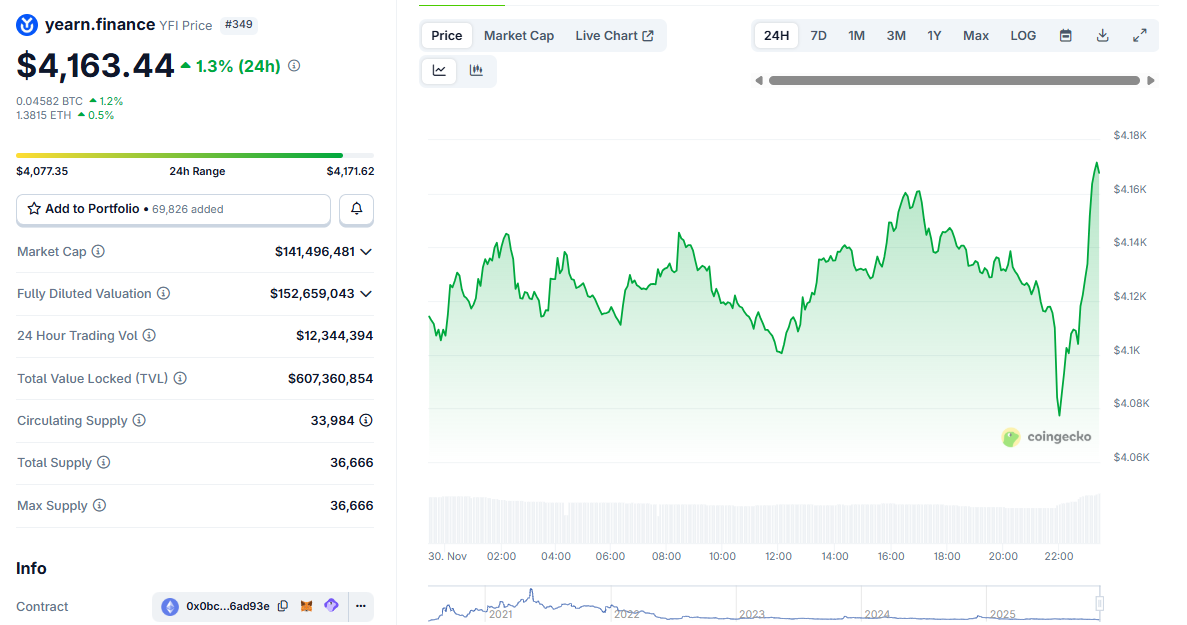
However, the market reaction created an unexpected dynamic. Shortly after the exploit was flagged on social media and by blockchain analysts, YFI’s price spiked sharply, climbing from near $4,080 to over $4,160 within an hour.
The move came despite the negative headlines surrounding the broader Yearn ecosystem.
 Yearn Finance YFI Token Price Chart. Source:
CoinGecko
Yearn Finance YFI Token Price Chart. Source:
CoinGecko
The price reaction appears tied to market misinterpretation in the early minutes of the incident. Initial claims of a “Yearn exploit” prompted high-leverage short positions on YFI, given the token’s thin liquidity and historically aggressive downside moves during hack events.
The attack was isolated to yETH and not Yearn’s Vaults, and short-sellers began covering their positions. This triggered a brief short squeeze and a volatility-driven price spike.
YFI’s circulating supply is only 33,984 tokens, making it one of the most illiquid major DeFi governance assets. This structure amplifies price movements, particularly during periods of uncertainty or rapid liquidation flow. Derivatives data also showed elevated funding volatility immediately after the exploit alert.
For now, losses appear contained to the yETH and Balancer pools touched by the exploit. Investigations remain ongoing, and it is unclear whether any recovery options exist for the stolen assets.
Markets will likely watch for a formal Yearn disclosure detailing root cause, patching efforts, and potential governance actions.
Disclaimer: The content of this article solely reflects the author's opinion and does not represent the platform in any capacity. This article is not intended to serve as a reference for making investment decisions.
You may also like
How PENGU USDT Sell Signals Influence Sentiment in the Crypto Market
- PENGU USDT's 2025 volatility exposed algorithmic stablecoin fragility, triggering DeFi sell-offs and reshaping trading strategies. - Contradictory technical indicators highlighted instability in algorithmic rebalancing mechanisms, while $66.6M team wallet outflows raised liquidity concerns. - Retail investors shifted to fiat-backed stablecoins post-UST collapse, accelerating USDC's market share growth amid regulatory ambiguity. - Market correlations (42-46% crypto-equity linkages) and macroeconomic press
Evaluating the Recent PENGU Price Rally: Could This Signal the Next Major Digital Asset Surge?

The COAI Price Reduction: Impact on Technology and Green Energy Industries
- COAI's 88% price drop in Nov 2025 exposed governance failures and regulatory ambiguity, triggering investor reassessment of AI-linked assets. - U.S. clean energy investment fell 36% due to Trump-era policy shifts, while global clean energy attracted $3.3 trillion in 2025 despite AI sector turmoil. - Investors migrated to stable AI stocks (Microsoft/Nvidia) and non-AI renewables, prioritizing transparency over speculative crypto projects like COAI. - The crisis accelerated capital reallocation toward ethi

Timeless Strategies for Investing in Today's Market
- R.W. McNeel and Warren Buffett share timeless value investing principles emphasizing emotional discipline, long-term vision, and intrinsic value. - Both stress faith in the U.S. economy, with Buffett's Berkshire Hathaway exemplifying this through long-term investments in American icons like Apple and Coca-Cola . - Retained earnings and margin of safety strategies, demonstrated by Apple's reinvestment and Berkshire's share buybacks, highlight compounding's role in mitigating market volatility. - Modern be

Trending news
MoreCrypto prices
More





