
Ethereum’s Fusaka Update: Paving the Way for 12,000 TPS Scalability by 2026
- Ethereum's Fusaka upgrade activates Holesky testnet on October 1, 2025, with mainnet launch scheduled for December 3, 2025. - Upgrade increases gas limit fivefold to 150 million units and introduces PeerDAS to boost data efficiency and reduce rollup costs. - Expected to enable 12,000 TPS by 2026 through enhanced throughput, Verkle Trees, and expanded smart contract capabilities. - Phased testnet rollout (Holesky, Sepolia, Hoodi) prioritizes risk mitigation, with sequential validation before mainnet deplo
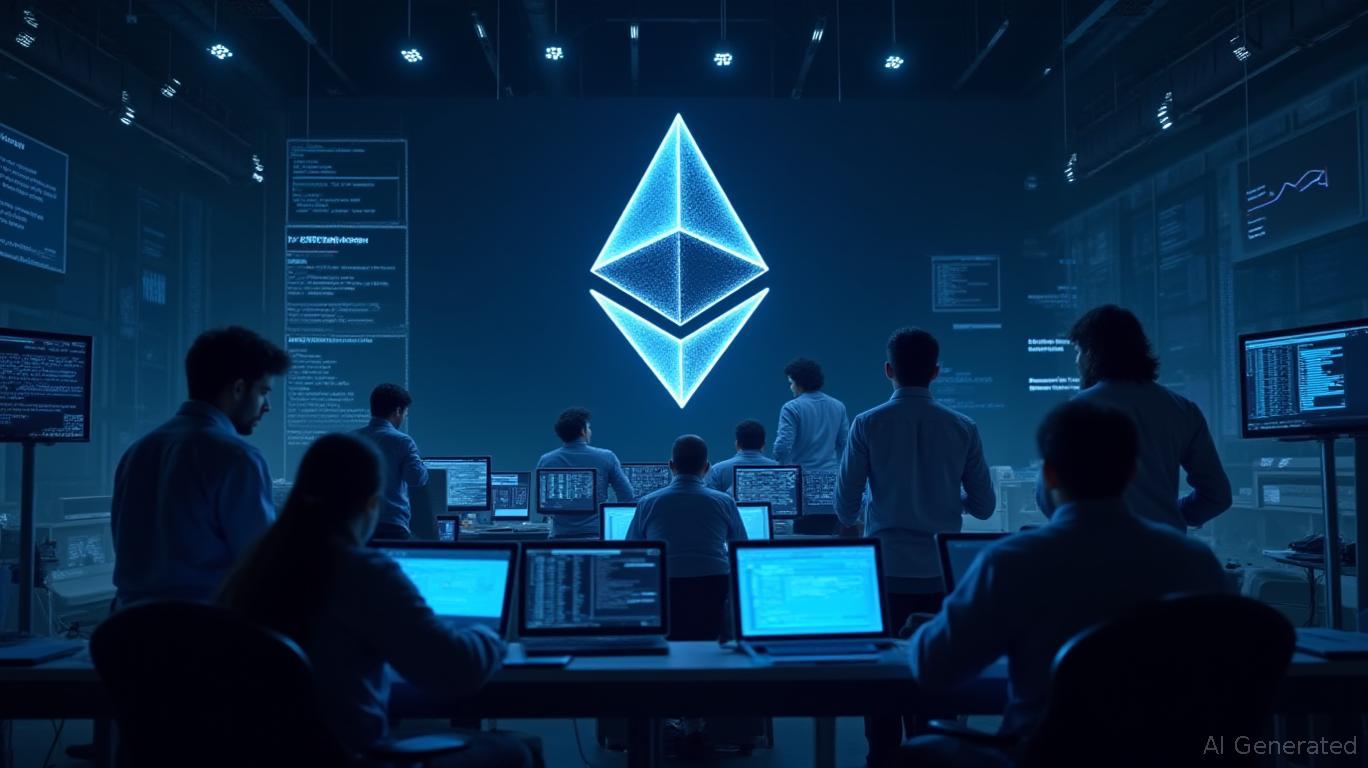
Ethereum’s Fusaka upgrade, a major milestone in the network’s journey toward greater scalability, will launch its initial public testnet on October 1, 2025, starting with Holesky. This event signals the start of a staged deployment across testnets, leading up to the mainnet release on December 3, 2025. The update will set a new default gas limit of 60 million—double the current 30 million—and will introduce Peer Data Availability Sampling (PeerDAS) to boost data throughput and lower rollup costs Ethereum Fusaka Upgrade Targets Dec 3 Mainnet Launch [ 1 ]. The timeline was confirmed by developers during the ACDC 165 meeting, with Sepolia and Hoodi testnets scheduled for October 16 and October 30, respectively, following Holesky Ethereum Sets Fusaka Upgrade Timeline: Testnets in October, … [ 2 ].
Increasing the gas limit is central to Fusaka’s scalability ambitions. By raising the block gas ceiling to 150 million,
The phased testnet rollout is designed to ensure thorough validation and minimize risk. Holesky, despite its planned retirement, was selected as the first testnet to rigorously test peer sampling mechanisms Ethereum Fusaka Upgrade Timeline On Testnets [ 4 ]. Sepolia and Hoodi will follow, each acting as a checkpoint for identifying bugs and optimizing performance before the mainnet goes live. Activations are scheduled mid-week (such as October 2 for Holesky) to coordinate with developer meetings and avoid scheduling conflicts Ethereum Fusaka Upgrade Timeline On Testnets [ 4 ].
Fusaka’s technical improvements go beyond just gas limits and data handling. The upgrade will also introduce Verkle Trees for more compact proofs, better EVM efficiency, and an increased smart contract code size limit (from 24KB to 48KB). These enhancements are expected to give developers the tools to create more advanced decentralized applications while preserving decentralization Ethereum Fusaka Upgrade Targets Dec 3 Mainnet Launch [ 1 ]. Experts predict that by 2026, PeerDAS could allow Ethereum to handle up to 12,000 transactions per second, putting it on par with centralized platforms in terms of throughput Countdown to Fusaka: Ethereum Locks Dates for … [ 3 ].
Following the mainnet launch on December 3, the Glamsterdam upgrade is expected in 2026, focusing on further scalability improvements like the full EVM Object Format (EOF) and faster block production Ethereum Fusaka Upgrade Targets Dec 3 Mainnet Launch [ 1 ]. Developers emphasize that this multi-phase strategy allows for comprehensive testing, with each testnet phase offering vital feedback for mainnet reliability. For end users, the transition will be mostly automatic, as wallets and exchanges will update in the background. However, validators and node operators must update their clients to avoid penalties Countdown to Fusaka: Ethereum Locks Dates for … [ 3 ].
The Fusaka upgrade is a significant leap forward for Ethereum’s technical foundation, focusing on behind-the-scenes enhancements rather than user-facing features. This approach sets the stage for a more scalable and robust blockchain network. As the testnets go live in the coming weeks, the community will closely track performance data to assess the upgrade’s impact on Ethereum’s future in decentralized finance and enterprise solutions Ethereum Fusaka Upgrade Targets Dec 3 Mainnet Launch [ 1 ].
Disclaimer: The content of this article solely reflects the author's opinion and does not represent the platform in any capacity. This article is not intended to serve as a reference for making investment decisions.
You may also like
How PENGU USDT Sell Signals Influence Sentiment in the Crypto Market
- PENGU USDT's 2025 volatility exposed algorithmic stablecoin fragility, triggering DeFi sell-offs and reshaping trading strategies. - Contradictory technical indicators highlighted instability in algorithmic rebalancing mechanisms, while $66.6M team wallet outflows raised liquidity concerns. - Retail investors shifted to fiat-backed stablecoins post-UST collapse, accelerating USDC's market share growth amid regulatory ambiguity. - Market correlations (42-46% crypto-equity linkages) and macroeconomic press
Evaluating the Recent PENGU Price Rally: Could This Signal the Next Major Digital Asset Surge?

The COAI Price Reduction: Impact on Technology and Green Energy Industries
- COAI's 88% price drop in Nov 2025 exposed governance failures and regulatory ambiguity, triggering investor reassessment of AI-linked assets. - U.S. clean energy investment fell 36% due to Trump-era policy shifts, while global clean energy attracted $3.3 trillion in 2025 despite AI sector turmoil. - Investors migrated to stable AI stocks (Microsoft/Nvidia) and non-AI renewables, prioritizing transparency over speculative crypto projects like COAI. - The crisis accelerated capital reallocation toward ethi

Timeless Strategies for Investing in Today's Market
- R.W. McNeel and Warren Buffett share timeless value investing principles emphasizing emotional discipline, long-term vision, and intrinsic value. - Both stress faith in the U.S. economy, with Buffett's Berkshire Hathaway exemplifying this through long-term investments in American icons like Apple and Coca-Cola . - Retained earnings and margin of safety strategies, demonstrated by Apple's reinvestment and Berkshire's share buybacks, highlight compounding's role in mitigating market volatility. - Modern be

Trending news
MoreCrypto prices
More





