
Ethereum’s Valuation Could Reach $20 Trillion by 2035, Analyst Projects

Ethereum (ETH) has been on a slow climb since late November, recovering from a dip to roughly $2,600, its lowest level since July. However, the cryptocurrency experienced a sharp decline on Friday, dropping nearly 5 % in a single trading session. Despite this volatility, research from long-term Ethereum investor William Mougayar points to a robust long-term outlook. According to his analysis, the network’s economic value is expected to grow significantly, with the potential for ETH’s total valuation to eventually reach trillions, even as short-term fluctuations continue to pressure prices.
In Brief
- William Mougayar projects Ethereum’s economic value could eventually reach trillions despite temporary price swings.
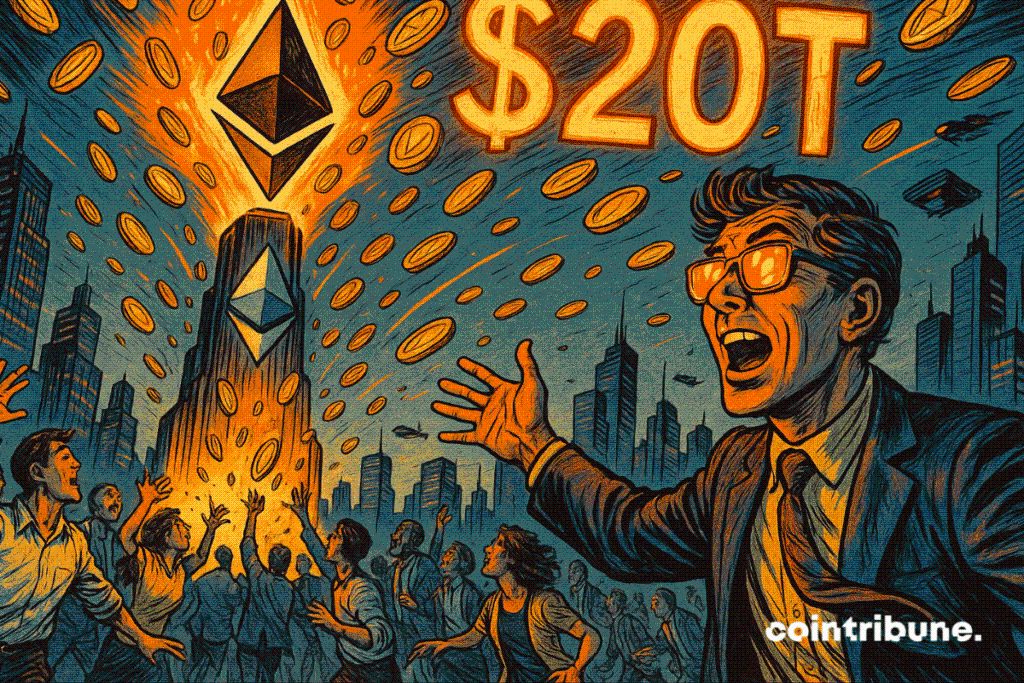
- Current intrinsic value of Ethereum is placed between $2 trillion and $6 trillion, with conservative estimates near $1 trillion and potential growth to $10–$20 trillion by 2035.
- Early signs of trading recovery appear as taker activity on Binance improves, suggesting renewed upward momentum may be possible in the short term.
Rethinking Ethereum’s Value
Mougayar’s report highlights that Ethereum is often assessed using models designed for traditional technology companies that generate profits. He suggests viewing ETH as a public good, similar to the core protocols that support the internet, such as TCP/IP. This misalignment, he argues, causes markets to misprice Ethereum, since its true value arises from shared benefits, open access, and collective usage rather than conventional revenue streams.
He further explained that most attempts to value Ethereum since its inception have relied on narrow and misleading frameworks. Common approaches—such as revenue-based analysis, discounted cash flow models, fee-focused economic assumptions, and token supply comparisons—fail to reflect the network’s actual nature. Ethereum is neither a company nor a profit-driven platform, and Mougayar stresses that its true value can only be understood by viewing ETH as a public good.
A Layered Approach to Valuation
The report introduces a valuation model that separates Ethereum’s total worth into three layers often overlooked by conventional metrics. The first layer captures value already recognized by the market, including Ethereum itself, Layer-2 solutions, and major decentralized finance (DeFi) assets, with a combined estimate of $0.6 trillion to $0.9 trillion.
The second layer assesses the economic activity dependent on Ethereum, covering stablecoin transactions, tokenized assets, non-fungible tokens (NFTs), and broader DeFi applications, with potential value ranging from $300 billion to $3 trillion. The final layer considers the less tangible benefits provided by the network, such as reduced risk, fewer intermediaries, and lower fraud exposure, which are estimated between $150 billion and $600 billion.
Applying this three-tiered framework, Mougayar places Ethereum’s current intrinsic value between $2 trillion and $6 trillion, while a conservative estimate puts it near $1 trillion today. Looking further ahead, if Ethereum grows into a global trust and settlement network akin to the internet’s foundational role, its valuation could reach $10 trillion to $20 trillion by 2035.
Under a very-high scenario, if Ethereum reaches “Internet-level public good” scale, around 2030-2035, we can map Ethereum’s place on an analogous curve. This yields a plausible upper bound of $10–20 trillion, assuming Ethereum becomes the “trust & settlement layer of the global economy” by 2035.
William Mougayar
Early Signs of Recovery in Ethereum Trading
While Ethereum’s longer-term prospects appear strong, its present-day price remains under pressure. Analysts have noted early indications of a rebound. Maartunn from CryptoQuant pointed to improved taker activity on Binance, with Net Taker Volume recovering to –$138 million from a low of –$500 million during heavy selling in late October.
Although still negative, this increase suggests that taker buyers are returning, hinting at the possibility of renewed upward momentum for Ethereum in the near term.
Disclaimer: The content of this article solely reflects the author's opinion and does not represent the platform in any capacity. This article is not intended to serve as a reference for making investment decisions.
You may also like
How CFTC-regulated platforms such as CleanTrade are transforming clean energy into a new category of tradable assets
- CFTC-approved CleanTrade transforms clean energy derivatives into standardized, liquid assets via its SEF platform, unlocking $16B in trading volume within two months. - By standardizing VPPAs/RECs and offering real-time analytics, CleanTrade bridges sustainability and profitability for institutional investors seeking ESG-aligned opportunities. - Early adopters like Cargill leverage CleanTrade to hedge energy costs while addressing fragmented markets, accelerating a $125T global clean energy derivatives

The Emergence of a Vibrant Clean Energy Market: How REsurety's CleanTrade Platform is Transforming Institutional Investments and ESG Approaches
- REsurety's CleanTrade platform, CFTC-approved for clean energy swaps, is transforming the market by enabling institutional trading of renewable assets with liquidity and transparency. - It addresses historical illiquidity in VPPAs/RECs through standardized contracts and real-time pricing, reducing transaction times and enabling $16B in notional value within two months. - The platform integrates ESG metrics with financial analysis, supporting 84% of institutional investors' growing demand for decarbonizat

COAI's Significant Recent Drop: Should Investors See This as a Chance to Buy or a Cautionary Signal?
- COAI's sharp stock decline sparks debate over short-term volatility vs. structural risks in South Africa's coal sector. - Weak domestic coal supply chains, US tariffs, and governance gaps amplify operational risks for export-dependent COAI. - Unclear AI policy implementation and media credibility issues deepen investor skepticism about COAI's transparency and adaptability. - Structural challenges including infrastructure bottlenecks and low AI adoption rates suggest the decline may reflect systemic indus

3 Future-Proof Cryptos to Add to Your Portfolio for 2026 — LINK, AVAX, and ALGO

Trending news
MoreCrypto prices
More





