
Tether Moves to Buy Juventus in Landmark Crypto Sports Deal

Tether has submitted a binding all-cash proposal to acquire a controlling stake in Juventus Football Club, committing up to €1 billion to support the 36-time Serie A champion in a landmark crypto-to-sports deal.
Tether has submitted a binding all-cash proposal to acquire Exor’s entire 65.4% stake in Juventus Football Club, the most successful club in Italian football history and a 36-time Serie A champion.
If approved by regulators and accepted by Exor, Tether said it would launch a public tender offer for the remaining shares at the same price, fully funded with its own capital. The company also committed to invest up to €1 billion to support and develop the club following completion.
What the Juventus Deal Means for Tether
The proposal, announced on December 12, marks one of the most ambitious moves yet by a crypto company into elite global sport. It signals a strategic shift for Tether from a pure stablecoin issuer to a long-term capital allocator in traditional institutions.
In the announcement, Tether CEO Paolo Ardoino described Juventus as a symbol of discipline, resilience, and continuity—values he said mirror how Tether has been built.
JUST IN: Tether wants to acquire Italian football club Juventus. Juventus is a 36-time domestic league champion, making it the most successful club in Italian football history.
— BeInCrypto (@beincrypto) December 12, 2025
From a business perspective, the acquisition would give Tether control of a globally recognised sports brand, expanding its footprint beyond financial infrastructure into media, entertainment, and global fan economies.
Unlike short-term sponsorships or fan token partnerships, ownership places Tether at the centre of governance and long-term strategy.
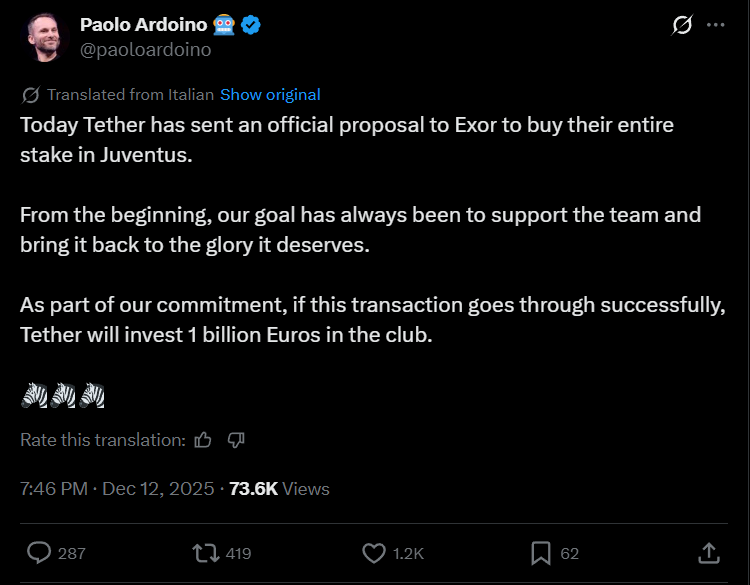 Tether Will Invest €1 Billion in Juvestus if the Deal Goes Through.
The move also reinforces Tether’s claim that it is operating from a position of strong balance-sheet health, able to deploy billions in capital without external financing.
Part of a Broader Expansion Strategy
The Juventus proposal follows a series of high-profile moves by Tether and USDT in recent weeks.
Tether recently secured regulatory recognition for USDT as an Accepted Fiat-Referenced Token in Abu Dhabi’s ADGM, expanding regulated use of the stablecoin across multiple blockchains.
At the same time, the company has explored tokenising its own equity, signalling openness to new corporate structures built on blockchain rails.
Beyond finance, Tether has also pushed into AI, robotics, and privacy-focused consumer technology, backing robotics firms and launching privacy-centric health and AI products.
Together, these developments point to a strategy of diversifying well beyond stablecoin issuance while
Juventus and Crypto: Not a First Connection
Juventus is no stranger to crypto involvement.
The club previously launched the $JUV fan token on the Chiliz and Socios platform, allowing fans to participate in polls and engagement initiatives. Juventus has also partnered with crypto companies as sponsors, including exchange-led branding deals in recent seasons.
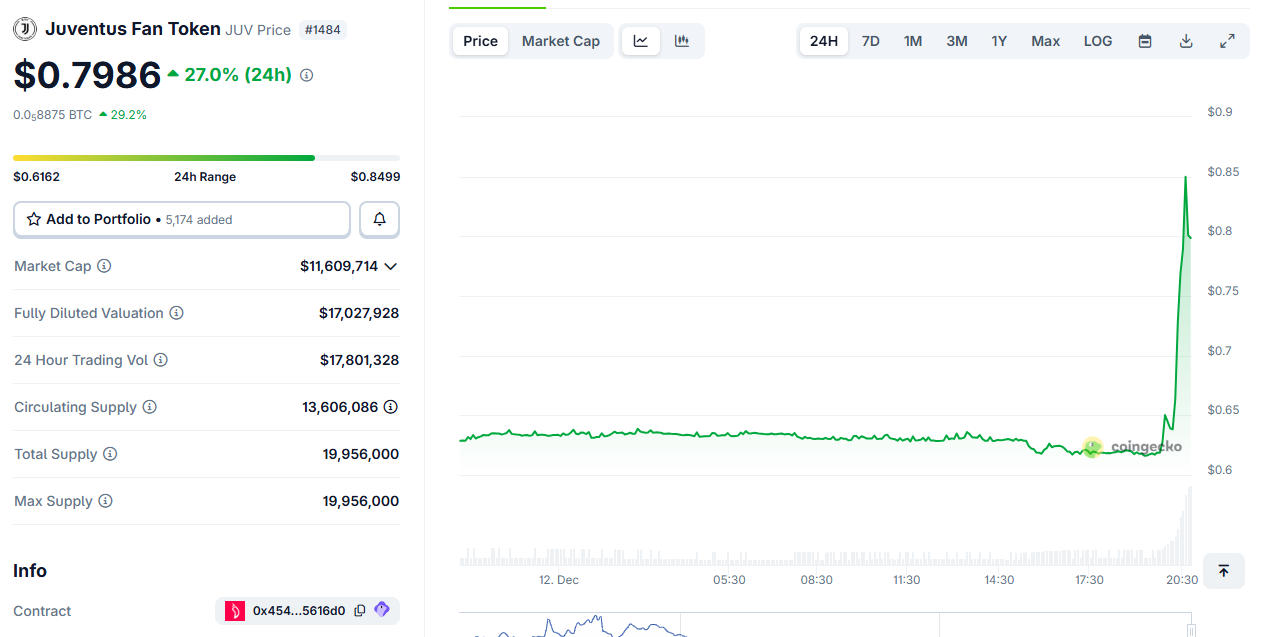 JUV Fan Token Surges After Tether Announcement. Source:
However, Tether’s proposal goes far beyond past crypto partnerships. If completed, it would represent full operational control by a digital asset firm—an unprecedented step for a club of Juventus’ stature.
The transaction remains subject to Exor’s acceptance, definitive legal agreements, and regulatory approvals. If those conditions are met, Tether plans to proceed with a public tender offer for remaining shares.
Disclaimer: The content of this article solely reflects the author's opinion and does not represent the platform in any capacity. This article is not intended to serve as a reference for making investment decisions.
You may also like
Navigating the Fluctuations of AI Tokens: Insights Gained from the ChainOpera AI Downturn
- ChainOpera AI's (COAI) 2025 token crash from $44.90 to $0.52 highlights systemic risks in AI-driven crypto projects due to centralized governance and regulatory ambiguity. - The CLARITY Act's regulatory framework created short-term volatility while exposing fragility in AI-linked tokens like algorithmic stablecoins xUSD and deUSD. - Investors must prioritize diversification, technical due diligence (e.g., EY six-pillar model), and compliance tools to mitigate risks in volatile AI crypto markets. - Succes

MMT and the Renewed Interest in Modern Monetary Theory within Policy Discussions
- Modern Monetary Theory (MMT) resurges in policy debates, challenging traditional fiscal rules by prioritizing resource availability and inflation risks over revenue constraints. - U.S. policymakers reject formal MMT adoption but align pragmatically with its principles through infrastructure investments and municipal bond financing. - MMT advocates argue debt sustainability is overstated, while critics warn of inflationary risks and fiscal misallocation in supply-constrained economies. - Global infrastruc

Tether fails with €1.1 billion offer for Juventus Turin

XRP Trades at $2.01 While Support and Resistance Contain Short-Term Movement

Trending news
MoreCrypto prices
More





