
Grasp Four Key Words to Get Ahead of the 2025 Crypto Mainstream Trends

Author: Wenser; Editor: Hao Fangzhou
Produced by: Odaily
Original Title: Four Key Words, Playing the Four Seasons of Crypto in 2025
2025 is about to pass. Standing at the end of the "Year of Crypto Mainstreaming," it is time to use some keywords to summarize the four quarters of this year and take a glimpse at how the world is being gradually infiltrated and transformed by cryptocurrencies.
The crypto world in 2025 has experienced many twists and turns, with sharp rises and falls: from Trump taking office as President of the United States in early January, to the US launching a tariff trade war in April; from Strategy leading the DAT treasury company trend and once making hundreds of billions of dollars in floating profits, to the flourishing and then silence of ETH, SOL treasury listed companies and even meme coin treasury companies; from stock tokenization platforms being regarded as "the best combination of DeFi and TradFi," to Nasdaq revolutionizing itself and joining the stock tokenization boom; from Hyperliquid and Aster's on-chain Perp DEX to the two prediction market giants with valuations exceeding 10 billions, Polymarket and Kalshi; from the GENIUS stablecoin regulatory bill to the stablecoin boom where everyone talks about PayFi; from crypto IPOs to the normalization of crypto ETFs... Amid countless struggles, battles, and reconciliations among capital, attention, and regulatory forces, amid countless wealth-making projects, meme jokes, and hacker incidents, amid the frenzy of FOMO, new highs, and buying rushes, and amid extreme fear, crashes, and black swans, the annual ring of the robust crypto industry tree has added another circle.
Behind the never-sleeping money are the ups and downs of meme coin players, the unprofitability of airdrop hunters, the large-scale absorption by Wall Street, and the regulatory green light from the US. Such a year is somewhat complicated—it is neither a complete bull market nor a cold bear market; compared to the clear-cut hot and cold, sector-rotating crypto markets of the past, the crypto industry in 2025, under the influence of Trump and many authoritarian government forces, is more like a monkey jumping up and down; some fall from grace, some rise with the tide, and as for success or failure, perhaps our soon-to-be-released "2025 Crypto Investment Memoir" will reveal more answers.
In this article, Odaily will review Crypto 2025 with four quarterly keywords.
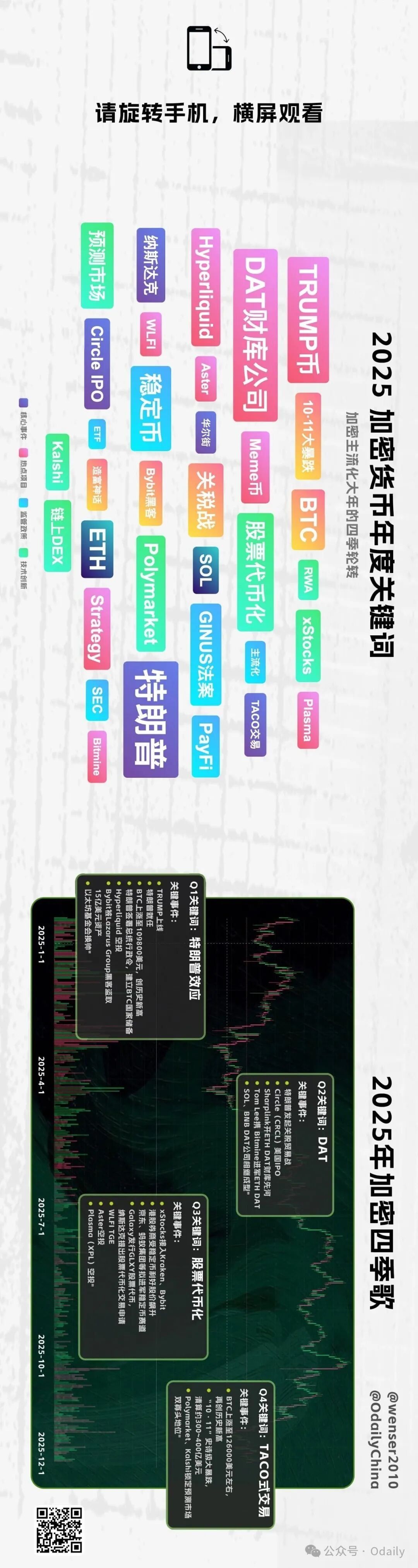

Crypto Spring: Trump Effect Continues, TRUMP Creates Wealth, Crypto Regulatory Framework Clarifies
In January, Trump officially took office as President of the United States.
Continuing the hot momentum after Trump won the election last year, the crypto market, after a brief consolidation, saw BTC prices once again approach the $100,000 mark.
Just three days before Trump took office, the TRUMP token, dubbed the "official Trump meme coin," brought the first wave of wealth creation this year to many crypto participants.
I still clearly remember that morning when my colleague first shared the TRUMP token contract, its total market cap (FDV) was only about $4 billions, but amid doubts like "Was Trump's account hacked?", "Does the US President dare to issue a coin?", "Is Trump trying to make one last profit before taking office?", TRUMP's market cap soared, quickly breaking through $10 billions, $30 billions, and finally reaching over $80 billions.
In this astonishing wealth-making frenzy, many Chinese meme players made a fortune, with some individuals earning profits as high as several millions or even over $20 millions. For a list of TRUMP wealth-making traders, we recommend reading "Who Are the TRUMP Million-Dollar Winners? Winning KOLs and Disappointed ETH Maxis."
This was also the "second spring" for the crypto market, reignited by Trump's personal influence after his election as President in November 2024.
Soon, the crypto market presented its own "gift" for Trump's inauguration—as of January 20, after a month, BTC once again broke its all-time high, rising to $109,800.
At that time, everyone regarded Trump as the undisputed "first crypto president." Perhaps many did not realize then that "water can carry a boat, but also overturn it"—what Trump brought to the crypto market was not only macro policy and regulatory benefits, but also a series of controversies, profit-taking, and repeated swings from his family's crypto projects.
On the other hand, the key point of the "Trump Effect" was whether he could directly improve the US crypto regulatory environment after taking office—
First, whether he could bring clearer boundaries and more friendly rules to crypto regulation through legislation and executive orders. Trump gradually fulfilled some of his promises, including replacing the SEC chairman with Paul Atkins, appointing David Sacks as the White House AI and crypto chief, and promoting the passage of the GENIUS stablecoin regulatory bill.
Second, the "BTC national strategic reserve" that the crypto market and many crypto-friendly politicians were watching. In early March, Trump signed a presidential executive order to establish a US Bitcoin strategic reserve using previously confiscated BTC assets. He also specifically emphasized: "This will not increase the burden on taxpayers." For details, see "Trump Establishes BTC Strategic Reserve as Promised, But Is Funding Purely from Forfeitures?"
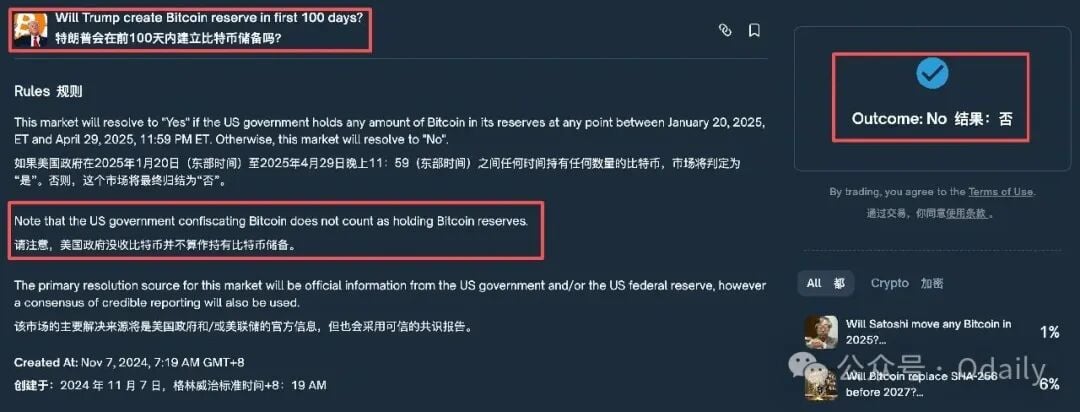
Nevertheless, the Polymarket bet on "Trump establishing a BTC national strategic reserve within 100 days of taking office" was ultimately settled as "No" (Odaily note: because the event rules stated that US government forfeited assets do not count as BTC reserves), which left many people frustrated, with some even calling it a "scam website" in the event's comment section.
At that time, the "insider whale" had already begun to show their prowess, with the "50x leverage insider" on Hyperliquid making millions of dollars from news such as "Trump establishing a crypto reserve." For details, see "Review of Hyperliquid Contract 'Insider' Operations: Precise Long and Short Positions."
This period also saw many controversial events involving Trump, including the "Melania token" incident after TRUMP and the LIBRA incident triggered by Argentine President Milei, both considered "dark masterpieces" of the Trump token group. In addition, the first quarter of the crypto market also witnessed a series of "historic events," including:
-
Hyperliquid's "largest airdrop of the year" made many on-chain players envious;
-
Bybit was suddenly attacked by the North Korean hacker group Lazarus Group, losing $1.5 billions in assets;
-
The much-criticized Ethereum Foundation underwent an update, with former executive director Aya promoted to chairwoman.
At that time, the industry did not expect that this "catfish" Trump would soon let the market witness an American version of "what brings success also brings failure."
Crypto Summer: DAT Treasury Companies, ETH Breaks New Highs, Stablecoins Take Center Stage
At the beginning of the second quarter, the crypto market was dealt a heavy blow—in early April, Trump launched a global "tariff trade war," causing global economic turmoil, with both the US stock market and crypto market suffering heavy losses.
On April 7, "Black Monday," the US stock market lost over $6 trillions in market value in a week, with the "Big Seven" US tech stocks, including Apple and Google, losing over $1.5 trillions. After nearly a month of volatility, the crypto market finally crashed—BTC fell below $80,000, hitting a low of $77,000; ETH dropped to $1,540, a new low since October 2023; total crypto market cap fell to $2.6 trillions, with a single-day drop of over 9%. Recommended reading: "Deep Dive into the Culprit Behind the Tariff War: Over $6 Trillions Wiped Out Overnight Because of Him?"
It was from then, after months of market downturn and foundation reforms, that ETH finally gained some momentum and possibility for a rebound. Recommended reading: "New Leadership, New Direction: Where Is the Ethereum Foundation Headed?"
Meanwhile, riding the wave of Circle's US IPO, stablecoins and PayFi gradually entered the mainstream view of the crypto market, regarded by many as the key to "mass adoption of crypto." Recommended reading: "A Decade of Stablecoins: Finally Recognized as 'Peer-to-Peer Electronic Cash' by the US Government," "The Golden Age of Stablecoins Begins: USDT to the Left, USDC to the Right"
In late May, with a command from Ethereum co-founder, Consensys and MetaMask founder Joseph Lubin, the US-listed company Sharplink transformed from a sports marketing company into the first "ETH treasury listed company." Since then, the DAT craze swept the entire crypto market, and ETH's price finally broke out of its downward spiral, successfully surpassing its previous all-time high of $4,800 a few months later and soaring to nearly $5,000.
Subsequently, "Wall Street wizard" Tom Lee joined the "DAT treasury craze" with the US-listed company Bitmine, making ETH treasury listed companies another "scenery" in the crypto world after BTC treasury listed companies led by Strategy.
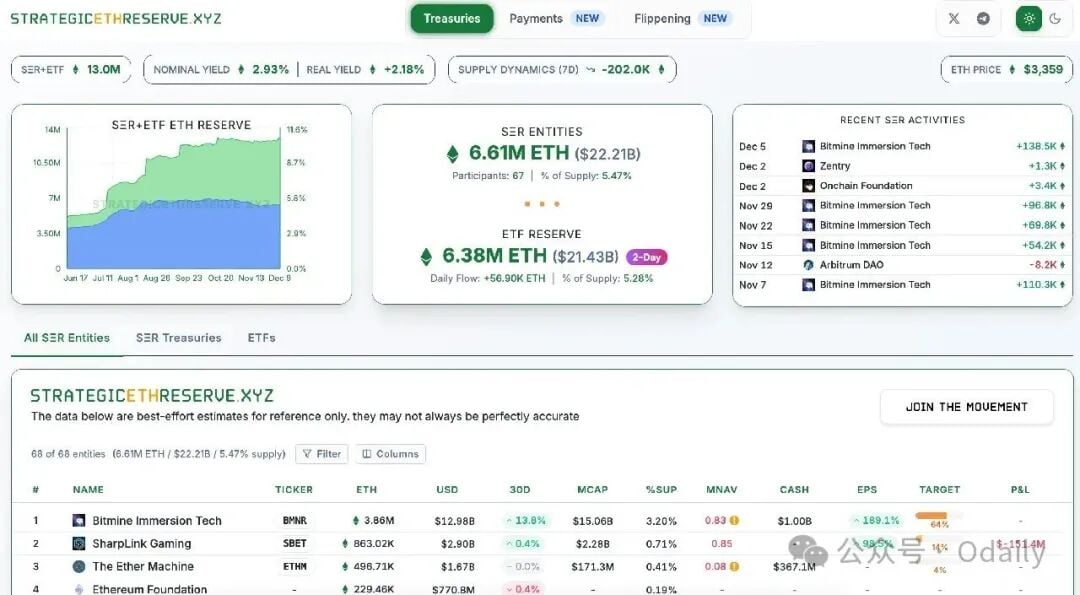
As of writing, according to strategicethreserve website data, the number of ETH treasury companies has increased to nearly 70, among which,
-
Bitmine (BMNR) tops the list with 3.86 million ETH holdings;
-
Sharplink (SBET) ranks second with over 860,000 ETH holdings;
-
ETH Machine (ETHM) ranks third with over 490,000 ETH holdings.
It is worth mentioning that the ETH holdings of these three DAT companies far exceed that of the Ethereum Foundation (less than 230,000 ETH).
With ETH treasury companies leading the way, SOL DAT companies, BNB DAT companies, and a series of meme coin DAT companies also sprang up like mushrooms after rain, with their stock prices rising and falling like roller coasters amid the noisy competition.
After the initial FOMO phase of transformation and as the crypto market entered a cooling-off period, ETH DAT companies represented by Bitmine are now facing tens of billions of dollars in paper losses, and many DAT treasury companies, including BTC reserve companies, have seen their market caps even fall below the value of their crypto assets due to a lack of real business support, with the mNAV (crypto assets/company market cap) of dozens of DAT companies dropping below 1.
The DAT companies of the crypto summer were still rejoicing, not yet understanding Zweig's words: "All gifts of fate, in secret, have already been priced," and that price was the persistently depressed stock price.
Of course, just as death often breeds new life, amid the DAT frenzy, the wind of stock tokenization also gradually blew into the crypto market, becoming an unstoppable trend that even the Nasdaq could not ignore, forcing it to join this "feast of capital" through self-revolution.
Crypto Autumn: Stock Tokenization, On-chain Perp DEX and Stablecoin Public Chains Compete
After Circle (CRCL) made a strong debut on the US stock market at the end of June, achieving a "tenfold surge in stock price," the enthusiasm for stablecoins and crypto concept stocks in both the crypto and traditional financial markets reached an unprecedented peak.
Boosted by positive news, the Hong Kong stock stablecoin sector and brokerage sector both rose, with many internet giants including JD.com and Ant Group announcing high-profile plans to enter the stablecoin track, attracting much attention. Recommended reading: "Hong Kong Stock Meme Season Arrives: Can Crypto Concept Stocks Support the Bull Market Backbone?"
Riding this wave, the RWA sector finally reached a huge turning point—stock tokenization was in full swing.
In early July, exchanges Kraken and Bybit announced the launch of stock tokenization trading via the xStocks platform, supporting dozens of tokenized US stocks including AAPL, TSLA, NVDA, etc. Since then, xStocks, which focuses on "on-chain US stock tokenization trading," has become the sole focus of the market spotlight, and MyStonks (now renamed MSX.com) has also attracted a large number of users and investors.
If the launch of the BTC spot ETF in early 2024 and the ETH spot ETF in July of that year gave crypto traders the title of "distinguished US stock traders," then the emergence of stock tokenization platforms this year truly bridged the "last mile of on-chain US stock trading," allowing even people like me, a "crypto speculator," to diversify asset allocation via on-chain tokenization platforms for the first time.
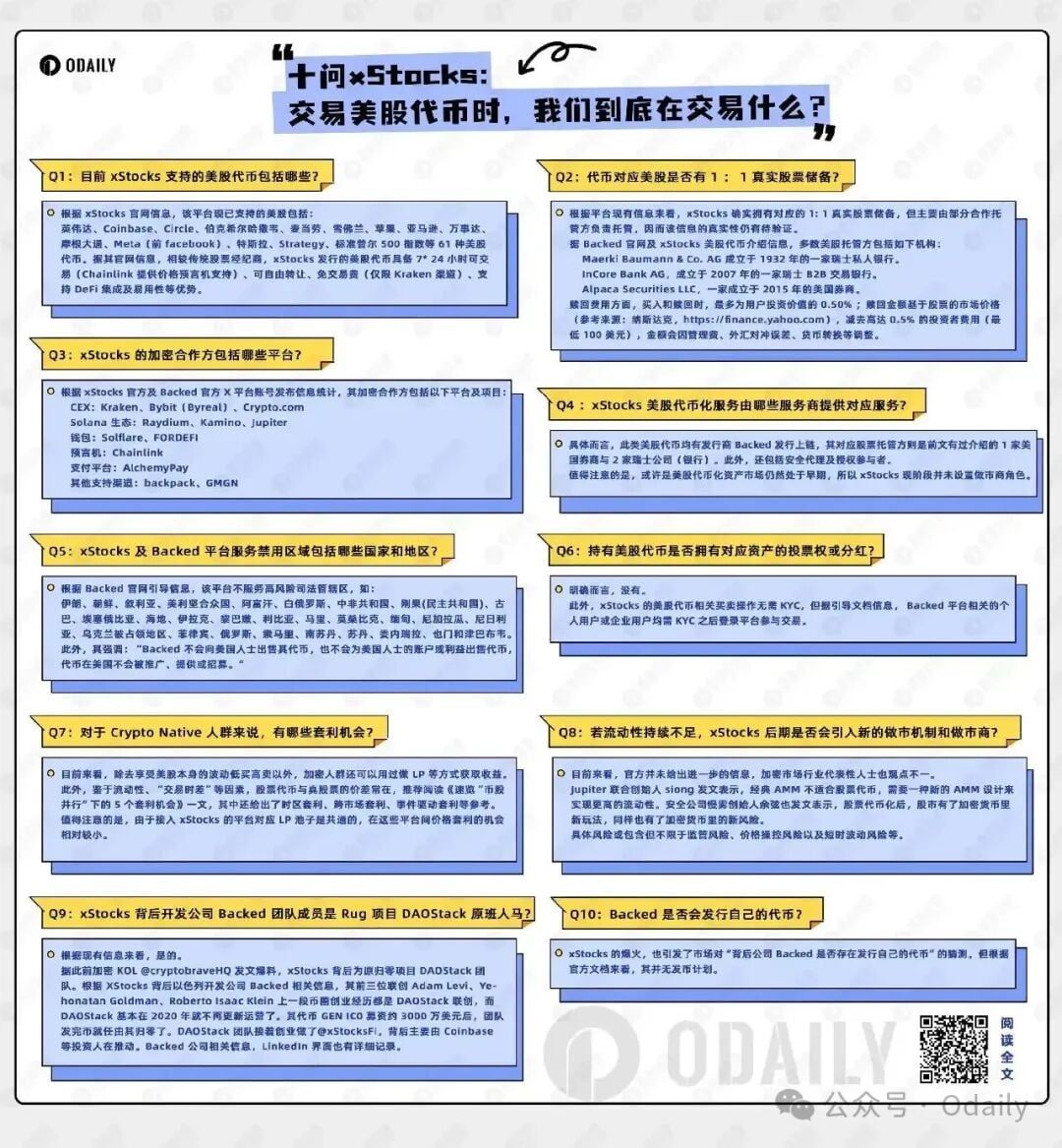
Odaily once gave a detailed introduction to the mechanisms behind xStocks and tokenized US stock trading platforms in "10 Questions About xStocks: What Are We Really Trading When Trading Tokenized US Stocks?" Looking back now, its basic principles and asset management model have not changed much; the difference is that after the rise of many US stock tokenization platforms, traditional giants have also begun their own awakening.
First, crypto asset management giant Galaxy proactively issued tokenized stocks; then, the Nasdaq, with quarterly trading volume reaching the 10 trillions level, proactively applied to the SEC for "tokenized stock trading." In the broad field of asset issuance and trading, the sensitivity of traditional giants is not lacking at all.
Meanwhile, the feast of the crypto-native market belonged to two major sectors:
First, the "on-chain Perp DEX war" after Hyperliquid—Aster from the BNB Chain ecosystem contributed another wealth-making miracle to the crypto market with an extremely violent "pump," with many people saying they "sold too early and missed millions of dollars";
Second, the two major wealth-making wonders of the stablecoin sector: one was the "savings event" launched by Plasma, a stablecoin public chain supported by the Tether CEO, which provided generous airdrops to many participants—some even deposited $1 and received XPL token airdrops worth over $9,000, a return of over 900 times; the other was the official launch of the Trump family crypto project WLFI, which, leveraging the momentum of its previous stablecoin USD1, gave people returns of up to 6 times at public sale prices of $0.05 and $0.15.
Looking at the prices of XPL and WLFI now, one can't help but sigh. According to Coingecko, XPL is currently priced at $0.17, down nearly 90% from its high of $1.67; WLFI is currently priced at $0.15, down nearly 50% from its high of $0.33.
At that moment, when countless people marveled at the endless opportunities, little did they know that what awaited the crypto industry was an "epic liquidation" far exceeding any previous crash in history.
Crypto Winter: After the 10·11 Crash, TACO Trading Validated Again, Prediction Markets Welcome Two Hundred-Billion-Dollar Giants
After BTC hit a new high of $126,000 in early October, people hoped the crypto market would continue the "Uptober" trend of previous years, but the "epic liquidation" on October 11 shattered those illusions and hopes.
This time, the fuse was once again Trump—on the night of October 10, Trump announced a 100% tariff hike, sending the fear index soaring. All three major US stock indices fell to varying degrees. The Nasdaq dropped nearly 3.5%, the S&P 500 fell 2.7%, and the Dow Jones dropped 1.9%.
The crypto market suffered from exchange system issues, compounded by the market's fragile psychology. BTC hit a low of $101,516, down 16% in 24 hours; ETH hit a low of $3,400, down 22% in 24 hours; SOL fell 31.83% in 24 hours. Altcoins were even bloodier.
The losses from this epic liquidation far exceeded previous major crashes such as 3·12, 5·19, and 9·4, with the real liquidation scale in the crypto market at least $30 billions to $40 billions.
Of course, risk breeds opportunity. As Odaily mentioned in articles like "Who Made Billions 'Licking Blood on the Knife Edge' During the Crash? Which Wealth Opportunities Are Right in Front of Us?" and "The Biggest Liquidation Day in Crypto History: Whale Knife Fights Behind the Scenes," whether it was high-leverage shorting or bottom-fishing, many people made a killing amid the chaos.
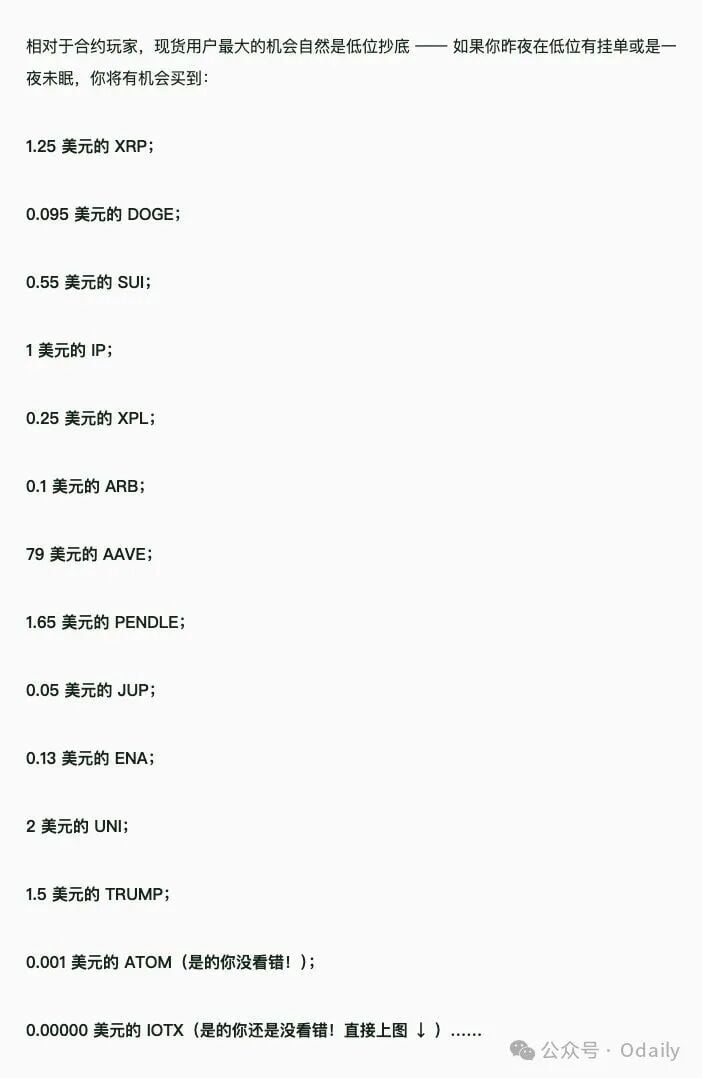
When the "TACO" trading style (Trump Always Chicken Out) was validated again, the crypto market finally began a slow self-repair. Unlike before, many traders had already lost most of their assets in that "Black Friday," fell into despair, and left the stage in silence.
It was in this dire market environment that prediction market platforms represented by Polymarket and Kalshi gradually became some of the few hotspots and trading arenas in the crypto market. The valuations of both soared within just a few months. After completing the latest $1 billions Series E round led by Paradigm, Kalshi's valuation soared to $11 billions; Polymarket, after completing a previous $2 billions round led by ICE Group (parent company of the NYSE), is now seeking a new round of financing at a valuation of $12 billions to $15 billions.
After all the twists and turns, the crypto market returned to Polymarket, the prediction market platform that successfully predicted Trump's victory in the "2024 US Presidential Election." As the seasons turn, the mainstreaming and popularization of the crypto industry continues.
Where will the future go? US regulation and traditional finance still largely determine the direction of the tide and the length of spring and winter. As for us, the crypto gold diggers, only by keeping up with the flow and assessing the situation can we perhaps find our own treasure of wealth.
Disclaimer: The content of this article solely reflects the author's opinion and does not represent the platform in any capacity. This article is not intended to serve as a reference for making investment decisions.
You may also like
Trend Research: Why Are We Still Bullish on ETH?
Against the backdrop of relatively accommodative expectations in both China and the US, which suppress asset downside volatility, and with extreme fear and capital sentiment not yet fully recovered, ETH remains in a favorable "buy zone."

x402 V2 Released: As AI Agents Begin to Have "Credit Cards," Which Projects Will Be Revalued?
BTC Unlikely To Hit $100K By Year-end, Say Prediction Markets

Trending news
MoreCrypto prices
More





