
MMT Token TGE and the Emerging Era of DeFi Liquidity Innovations
- Momentum Finance's MMT token TGE introduces strategic tokenomics and institutional-grade infrastructure to bridge DeFi and traditional finance. - MMT's 20.41% initial token unlock with extended vesting periods and liquidity buybacks aligns incentives for long-term ecosystem growth. - Ve(3,3) governance and compliance with U.S. GENIUS Act/MiCAR regulations address institutional concerns about security and regulatory uncertainty. - Cross-chain capabilities and RWA integration in MMT's roadmap position it a
Momentum (MMT) Token: Pioneering Institutional-Grade DeFi on Sui
Decentralized finance (DeFi) has long grappled with the challenge of balancing rapid innovation and institutional trust. The launch of the Momentum (MMT) token on the Sui blockchain signals a transformative moment for the sector. By introducing advanced tokenomics, robust governance mechanisms, and infrastructure built to institutional standards, MMT is reshaping DeFi’s foundation to appeal to traditional financial players. This overview examines how MMT’s focus on sustainable value and regulatory compliance positions it as a frontrunner in driving institutional engagement within the crypto landscape.
Innovative Tokenomics: Fostering Long-Term Ecosystem Health
MMT’s token distribution is carefully structured to encourage stability and discourage short-term speculation. At its Token Generation Event (TGE), 20.41% of the total 1 billion tokens became available, with allocations designed to support the ecosystem and community while minimizing immediate selling pressure. Specifically, 9% of tokens were allocated to ecosystem initiatives, 9.91% to community development, and 1.5% to the public sale. Meanwhile, tokens reserved for the team and investors are subject to extended lock-up periods, following Bitrue’s unlock schedule. This approach prioritizes liquidity and community-driven growth, both crucial for earning institutional trust.

Further reinforcing this commitment, investor tokens are locked for a full year before gradually unlocking over four years, while team tokens remain inaccessible for 48 months after the TGE. These vesting strategies help prevent early sell-offs, addressing a major concern for institutions wary of volatility. By tying token value to the protocol’s long-term performance, MMT encourages stakeholders to act as responsible participants rather than short-term speculators.
Advanced Liquidity Solutions: Connecting DeFi with Institutional Finance
MMT’s ve(3,3) governance model empowers holders to lock tokens in exchange for voting rights and a share of protocol fees. All trading fees and incentive rewards are distributed to veMMT holders, directly linking token ownership to the platform’s revenue. This transparent and predictable yield structure stands in contrast to the often unpredictable returns found in traditional DeFi, making it more attractive to institutional investors.
Additionally, MMT’s buyback program utilizes protocol earnings to repurchase tokens, reducing supply and increasing scarcity—an approach reminiscent of strategies used by established asset managers. Momentum Finance’s Concentrated Liquidity Market Maker (CLMM) decentralized exchange on Sui further enhances capital efficiency by reducing slippage and maximizing returns for liquidity providers. These features address institutional demands for deep liquidity and risk-managed, efficient capital deployment.
Institutional Integration: Security, Compliance, and Regulatory Readiness
Security and regulatory clarity have historically been major hurdles for institutional adoption of crypto. MMT addresses these challenges through two primary initiatives. First, the MSafe multi-signature wallet offers secure treasury management and token vesting across Sui, Aptos, and other Move-based blockchains, as highlighted by tokenomist.ai. This solution delivers the security and operational control institutions expect from traditional finance.
Second, MMT’s proactive alignment with emerging regulations—such as the U.S. GENIUS Act and the EU’s MiCAR framework—has increased institutional confidence, as noted in Bitget’s report. According to Phemex, nearly half of institutional investors consider evolving U.S. regulations a key factor in their digital asset strategies. By embedding compliance into its core design, MMT lowers the barriers that have previously kept traditional investors at bay.
Looking Ahead: Expanding Use Cases and Cross-Chain Liquidity
Momentum Finance’s future plans further solidify its role as a bridge between DeFi and established finance. Upcoming features include a perpetual futures decentralized exchange and the integration of tokenized real-world assets (RWAs), broadening the range of financial products available to institutions, as announced by Bitget. Cross-chain functionality via Wormhole and the Sui Bridge will extend MMT’s liquidity pools beyond the Sui network, promoting interoperability and global reach, as detailed in Phemex’s guide. These advancements cater to the increasing institutional appetite for tokenized assets and multi-chain investment strategies.
Conclusion: Setting a New Standard for Institutional DeFi
The introduction of the MMT token marks a significant step forward in DeFi’s evolution. By merging thoughtful tokenomics, governance-driven liquidity, and institutional-grade infrastructure, Momentum Finance offers a blueprint for attracting traditional investors. As the digital asset space matures, MMT exemplifies how DeFi can complement, rather than disrupt, established financial systems. For those seeking to participate in the next era of blockchain innovation, MMT stands out as a compelling example of how design and utility can drive meaningful change.
Disclaimer: The content of this article solely reflects the author's opinion and does not represent the platform in any capacity. This article is not intended to serve as a reference for making investment decisions.
You may also like
Investment Prospects in STEM Learning and Workforce-Ready Talent Streams: Linking with Astar 2.0
- Global STEM education demand surges as AI, blockchain, and biotech reshape industries, creating workforce skill gaps. - Astar 2.0's DeFi innovations (ZK Rollups, interoperability) indirectly support STEM through blockchain infrastructure and cross-chain collaboration. - U.S. and Singapore prioritize tech-integrated workforce strategies, aligning with Astar 2.0's potential to bridge DeFi and STEM education via scalable tools. - Investors can leverage Astar 2.0's $1.399B TVL and hybrid AMM-CEX model to fun

The ZK Transformation: Evaluating How Zero-Knowledge Technology Influences the Future Development of Blockchain
- ZK-rollups scale blockchain networks by bundling transactions, achieving 43,000 TPS and 30% lower gas fees, attracting institutions like Goldman Sachs and JPMorgan . - ZK technology resolves privacy-scalability paradox by enabling verifiable transactions without data exposure, adopted by EU regulators and enterprises like Nike and Sony . - Challenges persist: ZK-SNARKs require heavy computation, trusted setup risks exist, and privacy conflicts with AML regulations in some jurisdictions. - $725M+ VC inves

The Influence of Vitalik Buterin's Support for ZKsync on the Advancement of Scalable Blockchain Technologies: Evaluating the Prospects for Long-Term Investment in Pr
- Vitalik Buterin's 2025 endorsement of ZKsync accelerated its rise as a scalable Ethereum Layer-2 solution with 30,000 TPS and $3.3B TVL. - ZKsync's EVM compatibility and institutional partnerships contrast with StarkNet's quantum-resistant STARK proofs and Aztec's privacy-first architecture. - Analysts project ZK token prices at $0.40–$0.60 by 2025, while StarkNet faces adoption barriers and Aztec navigates regulatory challenges in privacy-focused DeFi. - The $7.59B ZKP market (2033 forecast) hinges on b
ZK Atlas Enhancement: Transforming Blockchain Scalability and Paving the Way for Institutional Integration
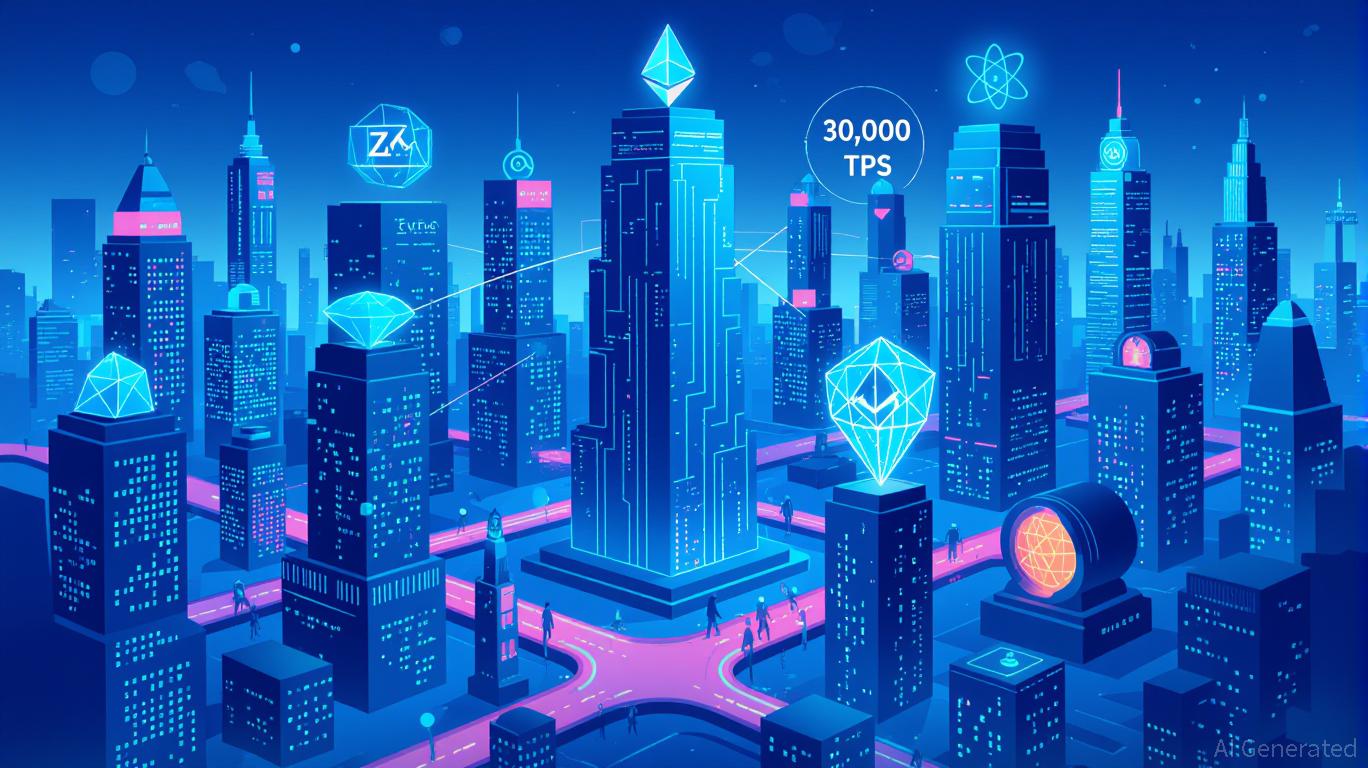
- ZKsync’s 2025 Atlas Upgrade achieves 15,000–43,000 TPS with $0.0001/transaction costs, boosting blockchain scalability for institutions. - Deutsche Bank , Sony , and Citi adopt ZKsync for tokenized assets and privacy-driven transactions, citing compliance and efficiency gains. - Market forecasts predict 60.7% CAGR for ZK Layer-2 solutions through 2031, with Fusaka upgrade targeting 30,000 TPS to solidify ZKsync’s leadership.
Trending news
MoreCrypto prices
More





