
COAI Experiences Significant Price Decline and the Enduring Insights for Investors Focused on the Long Term
- ChainOpera AI (COAI) collapsed from $44.90 to $0.52 in late 2025 due to market shifts, structural flaws, and regulatory uncertainty. - COAI's 88% supply concentration and 60 manipulative wallets exacerbated liquidity crises amid sector-wide AI token outflows to meme coins. - Regulatory pressures (GENIUS Act, FSB) and algorithmic stablecoin collapses (xUSD, deUSD) deepened distrust in DeFi, compounding COAI's decline. - Long-term investors may find opportunities in COAI's collapse by applying margin of sa
Lessons from the Fall of ChainOpera AI (COAI)
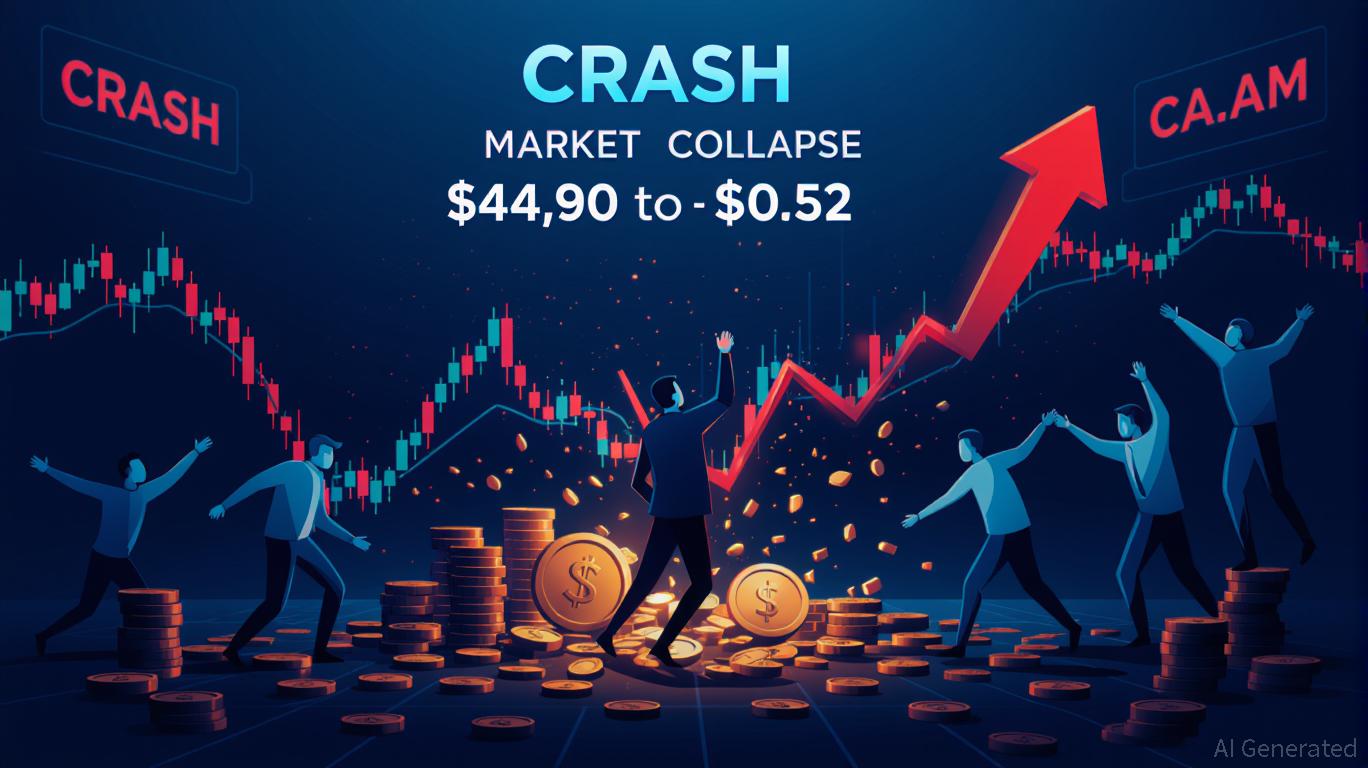
The dramatic downfall of ChainOpera AI (COAI) in late 2025 serves as a powerful example of how market sentiment, internal weaknesses, and regulatory ambiguity can converge to destabilize a digital asset. After reaching a peak of $44.90 in October 2025, COAI’s value crashed to just $0.52 by December—a staggering loss of over 99%. This sharp decline, fueled by multiple factors, highlights the unpredictable nature of AI-focused cryptocurrencies. However, for patient investors, such downturns may present rare opportunities—provided they adhere to foundational investment strategies such as maintaining a margin of safety, assessing intrinsic value, and recognizing the rhythm of market cycles.
Understanding COAI’s Downturn
COAI’s collapse was not an isolated incident but rather reflected broader changes within the crypto sector. A widespread shift from AI tokens to meme coins left COAI vulnerable to sudden liquidity shortages. Weaknesses in its token structure made matters worse: evidence of coordinated trading among 60 wallets pointed to possible manipulation, and with the top 10 holders owning 88% of the supply, the token was especially susceptible to panic-driven sell-offs. Additional uncertainty came from new regulations, such as the U.S. GENIUS Act and international oversight by the FSB.
The failure of algorithmic stablecoins like xUSD and deUSD further undermined confidence in DeFi platforms, compounding COAI’s difficulties. These events underscore a vital lesson: volatility in crypto is shaped not only by market cycles, but also by governance, liquidity, and regulatory risks.
Applying Classic Investment Wisdom in Crypto
Benjamin Graham’s value investing philosophy centers on the margin of safety—purchasing assets well below their true worth. In the case of COAI, determining intrinsic value is challenging due to the lack of cash flows or physical assets. Still, investors can adapt these principles by scrutinizing a token’s real-world use, adoption rate, and structural stability. For instance, COAI experienced a brief rebound in October 2025, spurred by BNB Chain’s growth and increased derivatives trading, suggesting underlying demand. Yet, without sustainable utility, these gains quickly faded.
Investor psychology adds another layer of complexity. Research indicates that crypto traders check prices an average of 14.5 times per day, heightening emotional reactions during market swings. Between 2023 and 2025, cycles of speculation and panic were common, fueled by overconfidence and fear of loss. Such behavioral patterns can create mispriced assets, offering opportunities for disciplined value investors who avoid following the crowd. A notable example is the Bybit flash crash in March 2025, where a $1.2 billion liquidation triggered a 23% drop in Bitcoin within 40 minutes—demonstrating the importance of rational, data-driven decisions.
Spotting Opportunities After a Crash
Market crashes often pave the way for significant investment opportunities, as seen with Bitcoin’s resurgence in 2023. According to Bitwise’s Matt Hougan, Bitcoin’s 29% decline from its high represented a rare chance for long-term investors. Similarly, COAI’s steep fall could present value, but only if its fundamentals support a recovery. This demands careful evaluation—issues like concentrated token ownership and governance must be balanced against the project’s ability to adapt to new regulations.
Maintaining a margin of safety remains crucial. In traditional investing, this might mean buying shares at half their estimated value. In the crypto world, it involves judging a token’s practical utility, network strength, and resistance to manipulation. COAI’s 88% drop over the year signals deep pessimism, but whether this reflects its true worth depends on its capacity to resolve underlying issues.
The Importance of Market Cycles and Patience
Market cycles are unavoidable, but their effects depend on how investors respond. The Wall Street Cheat Sheet outlines emotional phases from disbelief to euphoria, providing a framework for identifying market turning points. COAI’s journey from exuberance in October 2025 to despair by December mirrors these emotional shifts. Long-term investors are best served by focusing on enduring value rather than attempting to time the market.
Historical examples, such as the TerraUSD collapse in 2022, show that those who relied on value-based analysis—considering governance and technological soundness—were better equipped to recover. COAI’s future will similarly depend on its ability to restore confidence through transparency and practical use, as highlighted by recent research.
Final Thoughts
The story of COAI’s collapse is both a warning and a reminder of the enduring value of sound investment principles. For those with a long-term perspective, the challenge is to distinguish between temporary panic and genuine undervaluation. By prioritizing margin of safety, evaluating intrinsic value through utility and governance, and understanding the psychological cycles of the market, investors can approach the crypto sector with greater discipline. History suggests that the greatest opportunities often emerge when fundamentals are overlooked—and COAI’s experience is a testament to this truth.
Disclaimer: The content of this article solely reflects the author's opinion and does not represent the platform in any capacity. This article is not intended to serve as a reference for making investment decisions.
You may also like
New Prospects in Security Technology and Advancements in Cybersecurity
- Post-cyberwarfare era demands AI-integrated defense-grade security as cyber threats evolve, with AI cybersecurity market projected to grow from $22.4B (2023) to $136.18B by 2032 at 24.81% CAGR. - Key drivers include cloud/IoT expansion, regulatory mandates (e.g., U.S. NSF privacy research), and institutional innovation like federal talent programs and startup collaborations. - Real-world applications show AI mitigating ransomware (Darktrace) and zero-day attacks (Cylance), while military operations lever

Assessing How the TGE of MMT Token Influences the Cryptocurrency Ecosystem
- Momentum Finance's MMT token TGE on Sui blockchain highlights innovative DeFi tokenomics with 42.72% community allocation and ve(3,3) governance model. - Post-TGE volatility (4,000% surge followed by 70% correction) reflects market dynamics, but technical indicators and buybacks suggest long-term resilience. - MMT's $250-350M FDV target and Sui integration demonstrate strategic benchmarks, offering lessons for balancing innovation, sustainability, and institutional trust in emerging blockchain projects.
Momentum (MMT) and the Rising Popularity Among Retail Investors: Insights from Behavioral Finance
- Momentum (MMT) price surges mirror 2021 GameStop dynamics, driven by social media sentiment and behavioral biases like overconfidence and herd behavior. - Retail-driven speculation distorts market efficiency, with 21% trading volume reflecting emotional decision-making over fundamentals, as shown by Bitget and academic studies. - Institutional investors exploit these anomalies through contrarian strategies, while regulators scrutinize social media's role in destabilizing traditional market models. - The

Timeless Strategies for Investing in Today's World
- McNeel and Buffett's value investing principles remain vital in today's volatile crypto markets. - Crypto surges driven by FOMO and hype, like MMT's 2025 rise, highlight risks of ignoring these strategies. - Buffett's focus on fundamentals and emotional discipline offers a structured approach to avoid speculative traps. - Case studies show adherence to these principles can mitigate losses during market corrections. - Timeless tenets of patience and intrinsic value are essential for long-term success in u

Trending news
MoreCrypto prices
More





