
Borrowing short to repay long: The Bank of England and the Bank of Japan lead the shift from long-term bonds to high-frequency "interest rate gambling"

If expectations are not met, the government will face risks of uncontrollable costs and fiscal sustainability due to frequent rollovers.
If expectations are not met, the government will face the risk of uncontrolled costs and fiscal sustainability due to frequent rollovers.
Written by: Zhang Yaqi
Source: Wallstreetcn
Governments of major global economies are quietly adjusting their debt strategies, increasingly moving away from traditional long-term bonds and instead embracing shorter-term debt.
Leading this trend are the UK and Japan. According to reports, the UK has cut its issuance of long-term government bonds to a historic low this year and is considering expanding its ultra-short-term bill market. Meanwhile, after a sell-off in long-term bonds, the Japanese government is also responding to market calls by planning to increase the issuance of short-term debt.
The shift in strategy is driven by central banks in various countries gradually withdrawing from years-long bond-buying programs, resulting in reduced demand for long-term bonds and rising government borrowing costs. Facing already high debt levels, policymakers are opting to issue lower-yielding but more frequently rolled-over short-term bills, hoping to ease fiscal pressure. However, this is essentially a bet that interest rates will fall in the future.
This move is not an isolated case. The US is increasingly relying on short-term Treasury bills to finance its federal deficit, and countries like Australia have proposed similar policies. According to the Bloomberg Aggregate Bond Index, the average duration of global government bonds has fallen to its lowest level since 2014. Nevertheless, the UK and Japan are undoubtedly the two countries experiencing the sharpest decline in demand for long-term bonds and the most aggressive policy adjustments.
Shift in Demand, Traditional Buyers Exit
The core driving force behind this global shift is the structural change in demand from traditional buyers of long-term bonds. Central banks in various countries are shrinking their balance sheets, pushing up government financing costs.
In the UK, fixed-income pension plans that have been stable buyers of long-term bonds for decades are now mostly winding down, resulting in a huge gap in market demand. Japan faces a similar situation. Takahiro Otsuka, Senior Fixed Income Strategist at Mitsubishi UFJ Morgan Stanley Securities, pointed out that banks and life insurance companies' demand for ultra-long-term bonds is not what it used to be. In addition, investors are concerned about Sanae Takaichi's plan to finance economic stimulus through a supplementary budget, believing this could bring additional bond supply pressure.
Market dynamics themselves have also made short-term borrowing more attractive. Currently, the yield gap between long- and short-term bonds is widening significantly. This year, the yield on the UK's 30-year government bond hit its highest level since 1998, and its premium over the 2-year government bond rose to its highest since 2017. In Japan, this spread has also widened to its highest level since at least 2006.
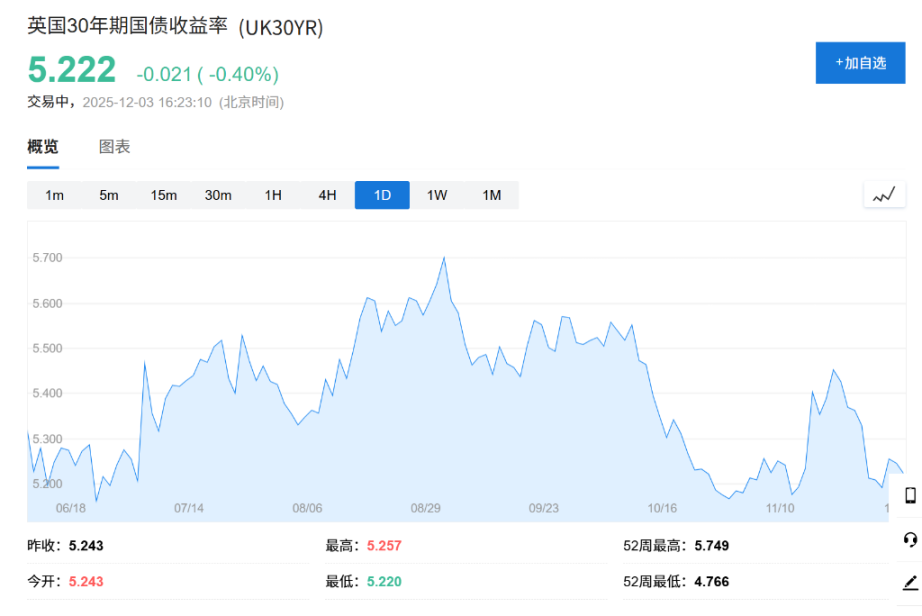
The huge yield spread makes issuing short-term debt extremely attractive in terms of cost. Data shows that in this fiscal year, UK government bonds with a duration of less than 7 years are expected to account for 44% of total new issuance, an increase of nearly 20 percentage points compared to the 2015-16 fiscal year. In Japan, bonds with a duration of 5 years or less are expected to account for about 60% of total new issuance this fiscal year, up from 56% in fiscal 2015.
"Interest Rate Gamble" and Fiscal Sustainability Risks
However, aggressively shortening debt duration is essentially a bet by governments that long-term bond yields are too high and will fall in the future. The risk of this strategy is that if interest rates do not fall as expected, or even rise, governments will face uncontrolled costs when frequently rolling over debt.
"The risk is that if rates go up, your interest bill will suddenly increase sharply," said Evelyne Gomez-Liechti, a strategist at Mizuho International in London.
Hiroshi Namioka, Chief Strategist at T&D Asset Management, also warned:
"If the duration is only two years, it means refinancing must be very frequent. Continuously rolling over short-term loans will raise questions about fiscal sustainability, and we need to be wary of how this will make the future fiscal outlook more unpredictable."
Although the US is also increasing its issuance of short-term Treasury bills, its market situation is significantly different from other countries. As of the end of October, short-term Treasury bills accounted for about 22% of the total outstanding US national debt. According to Citigroup forecasts, this proportion could rise to 26% by the end of 2027.
Unlike the UK and Japanese markets, the US has a huge and sustained demand for such short-term assets. More than $8 trillion is parked in money market funds, allowing the US Treasury to flexibly adjust according to market demand. US Treasury Secretary Scott Bessent said last month that his department is "closely monitoring potential long-term changes in demand for specific types of US Treasuries" and will respond accordingly.
Gennadiy Goldberg, Head of US Rates Strategy at TD Securities, believes this allows "the Treasury to rely more on bill issuance, thereby easing pressure on long-end yields, as they can delay plans to increase the size of coupon-bearing bond auctions until the end of 2026."
Disclaimer: The content of this article solely reflects the author's opinion and does not represent the platform in any capacity. This article is not intended to serve as a reference for making investment decisions.
You may also like
COC the Game Changer: When Everything in GameFi Becomes "Verifiable", the Era of P2E 3.0 Begins
The article analyzes the development of the GameFi sector from Axie Infinity to Telegram games, pointing out that Play to Earn 1.0 failed due to the collapse of its economic model and trust issues, while Play for Airdrop was short-lived because it could not retain users. COC Game has introduced the VWA mechanism, which verifies key data on-chain in an attempt to address trust issues and build a sustainable economic model. Summary generated by Mars AI. This summary was generated by the Mars AI model, and its accuracy and completeness are still being iteratively updated.

BTC Volatility Weekly Review (November 17 - December 1)
Key metrics (from 4:00 PM HKT on November 17 to 4:00 PM HKT on December 1): BTC/USD: -9.6% (...

When all GameFi tokens have dropped out of the TOP 100, can COC reignite the narrative with a Bitcoin economic model?
On November 27, $COC mining will be launched. The opportunity to mine the first block won't wait for anyone.

Ethereum's Next Decade: From "Verifiable Computer" to "Internet Property Rights"
Fede, the founder of LambdaClass, provides an in-depth explanation of anti-fragility, the 1 Gigagas scaling goal, and the vision for Lean Ethereum.

Trending news
MoreCrypto prices
More






