
The ZK Atlas Upgrade: Transforming the Landscape of Web3 Infrastructure?
- ZKsync's 2025 Atlas Upgrade tackles blockchain's scalability trilemma via modular architecture, ZK proofs, and institutional-grade infrastructure. - Technical breakthroughs include 15,000-43,000 TPS speeds, $0.0001/tx costs, and EVM compatibility, attracting Deutsche Bank , Sony , and $300M daily trading volumes. - ZK token surged 50% post-upgrade, with analysts projecting $5.13 valuation due to deflationary tokenomics and 230% developer participation growth. - Institutional adoption spans $1.7B tokenize
ZK Atlas Upgrade: Redefining Blockchain Scalability and Adoption
The blockchain sector has long struggled to achieve an optimal balance between security, decentralization, and transaction throughput. In October 2025, ZKsync introduced the ZK Atlas Upgrade, a significant step forward in addressing these challenges. By leveraging modular design, advanced zero-knowledge proof technology, and robust institutional infrastructure, this upgrade has generated considerable excitement among both investors and developers. This analysis explores the upgrade’s technological advancements, its impact on market adoption, and the broader implications for decentralized networks.
Technological Innovations: Enhancing Performance and Flexibility
At the heart of the ZK Atlas Upgrade are breakthroughs that dramatically improve transaction scalability while safeguarding privacy and security. The Atlas Sequencer is capable of processing between 15,000 and 43,000 transactions per second (TPS), achieving finality in as little as 1 to 500 milliseconds depending on the asset involved. For comparison, Ethereum currently supports only about 15 to 45 TPS, highlighting the magnitude of ZKsync’s advancement.

Another key component is the Airbender Prover, a zkVM built on RISC-V architecture, which reduces proof generation costs to as little as $0.0001 per transaction. This low cost, combined with near-instant finality, makes ZKsync an attractive option for high-frequency trading and institutional applications, including cross-chain settlements and tokenization of real-world assets. The upgrade also maintains EVM compatibility, allowing seamless integration with existing Ethereum-based projects—a crucial factor for developer adoption.
Advanced data compression methods further boost scalability by minimizing on-chain storage requirements and improving data availability. These enhancements have drawn major enterprises such as Deutsche Bank and Sony, who now utilize ZKsync for confidential financial transactions and digital rights management.
Market Response and Tokenomics: Positive Momentum
The ZK Atlas Upgrade has triggered a substantial increase in the value of the ZK token, with prices rising by 50% to trade between $0.063 and $0.064 and daily fluctuations of 8–12%. This surge is supported by a deflationary economic model that incorporates buybacks, token burning, and staking incentives, creating scarcity and price stability. Increased staking participation has further reinforced the token’s value. Market analysts forecast that the ZK token could reach $5.13, fueled by expanding institutional interest and growing network activity.
Investor optimism is also reflected in a 230% jump in developer engagement, driven by zkEVM tools and flexible Layer 2/3 infrastructure. On-chain statistics, such as achieving 15,000 TPS after the upgrade and recording $300 million in daily trading volume, highlight the network’s rapid growth. Institutional staking services like HashStaking are seeing greater demand for multichain strategies, signaling wider acceptance of ZK-based technologies.
Enterprise Use Cases and Institutional Integration
The influence of the ZK Atlas Upgrade extends beyond technical metrics, as real-world deployments showcase its transformative potential for finance and enterprise operations. Deutsche Bank and Memento have adopted ZKsync for fund management and tokenized private credit, while Tradable has brought $1.7 billion in alternative assets onto the platform. These implementations benefit from ZKsync’s KYC/AML compliance, privacy features, and real-time settlement capabilities, effectively addressing regulatory and operational challenges faced by institutions.
Adoption is spreading across industries. UBS and Walmart are now utilizing ZK-based solutions for cross-chain settlements and supply chain transparency. Sisvida Exchange’s acquisition of a U.S. MSB license highlights increasing institutional confidence in ZK platforms. Additionally, Cantina’s comprehensive smart contract audits have validated ZKsync’s cryptographic foundations, strengthening its reputation in security-critical environments.
Regulatory Developments and Competitive Landscape
The passage of the U.S. GENIUS and CLARITY Acts in 2025 has brought much-needed regulatory certainty to ZK technologies, easing compliance for financial institutions. This favorable legal environment, combined with ZKsync’s emphasis on privacy and regulatory alignment, has accelerated institutional participation. The total value locked (TVL) in the ZK sector now surpasses $3.5 billion, with platforms like StarkNet and ZKsync collectively handling over one million transactions daily.
Despite these achievements, challenges persist. While ZKsync’s modular framework offers adaptability, integrating with legacy systems and competing with other Layer 2 solutions such as StarkNet and Arbitrum may impact its long-term leadership. Furthermore, ongoing improvements in the energy efficiency of ZK proofs and the scalability of data availability solutions will be essential for sustained progress.
Conclusion: Transformative Potential with Cautionary Notes
The ZK Atlas Upgrade has fundamentally altered the blockchain landscape, positioning ZKsync as a frontrunner in enterprise-level Web3 infrastructure. Its technical strengths, combined with strong investor confidence and increasing institutional adoption, point to a significant shift in the decentralized ecosystem.
Nevertheless, the journey forward involves navigating regulatory changes, technological competition, and the need for continued developer engagement. For investors, the ZK Atlas Upgrade presents a promising opportunity, but it also requires careful consideration of both its advantages and potential risks.
Disclaimer: The content of this article solely reflects the author's opinion and does not represent the platform in any capacity. This article is not intended to serve as a reference for making investment decisions.
You may also like
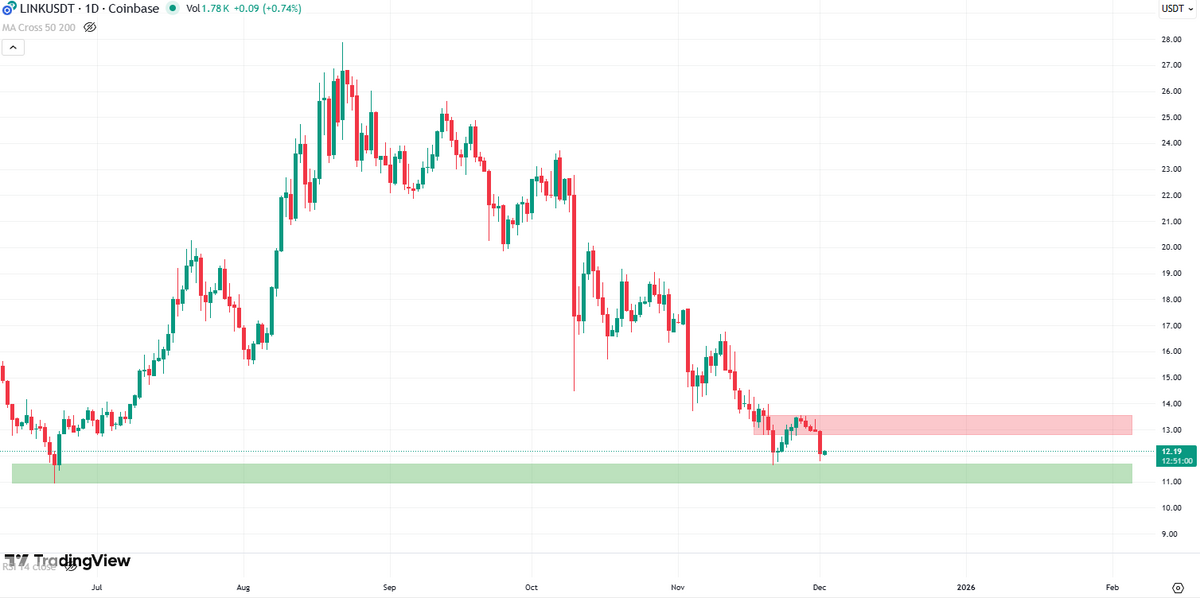
Chainlink ETF Set to Debut as LINK Slips Amid Market Weakness
Striking baristas win $38.9 million in compensation, yet contract disputes continue
- Starbucks settles NYC Fair Workweek Law violations for $38.9M, including $35.5M restitution to 15,000+ workers. - Striking baristas demand collective bargaining amid ongoing labor disputes and unionization efforts at 550 stores. - Mayor-elect Mamdani and Sen. Sanders join protests, framing demands as moral issues against corporate resistance. - Settlement addresses 500,000 scheduling violations since 2021, with workers receiving $50/week compensation. - Starbucks defends labor law complexity but faces cr

Alphabet's AI-driven ecosystem accelerates flywheel momentum, driving shares up by 68% in 2025
- Alphabet's stock surged 68% in 2025, outperforming peers like Microsoft and Nvidia , driven by strong AI monetization and cloud growth. - Analysts raised price targets to $375-$335, citing Google Cloud's $15.2B Q3 revenue (34% YoY) and $155B cloud backlog growth. - The company's AI ecosystem spans Search, YouTube, and Workspace, generating premium subscriptions and ad yield through Gemini's 650M MAUs. - Projected cloud revenue could exceed estimates by $40B, but risks include regulatory scrutiny and comp

XRP News Today: Vanguard Changes Position on Crypto ETFs, Pointing to Market Maturity and Increased Demand
- Vanguard Group will enable crypto ETF trading on its platform from December 2, 2025, reversing years of opposition to digital assets. - The firm supports Bitcoin , Ethereum , XRP , and Solana ETFs but excludes memecoins, treating crypto as non-core assets like gold . - Market maturation, $25B+ ETF inflows, and regulatory compliance drive the shift, positioning Vanguard as the last major U.S. broker to adopt crypto ETFs. - The move reflects growing institutional confidence in regulated crypto structures a
Trending news
MoreCrypto prices
More





