
Bitcoin News Today: Bitcoin Holders Lower Tax Burden, Gain BTC with Arch's TaxShield
- Arch Lending launches TaxShield, a Bitcoin-backed loan program enabling investors to convert tax liabilities into mining assets via Blockware infrastructure. - The service leverages U.S. tax rules to allow 100% first-year depreciation on mining hardware, reducing taxable income while generating monthly BTC rewards. - High-net-worth investors could cut federal tax bills by ~$400,000 using $1M in income, with proceeds reinvestable or used to service loans. - Arch expands Bitcoin's utility through a DeFi pl
As more Bitcoin owners look for ways to make the most of their assets, Arch Lending, a crypto-backed lending company based in New York, has rolled out an innovative offering aimed at boosting both tax savings and compounding returns. Their latest solution,

Through TaxShield, qualified investors can use their Bitcoin as collateral to secure overcollateralized loans from Arch. The funds from these loans are then used to acquire mining equipment hosted by Blockware, which takes care of setup, maintenance, and electricity. Investors are able to claim full bonus depreciation on the mining hardware in the first year, significantly lowering their taxable income. At the same time, they continue to benefit from any increase in Bitcoin’s value and receive monthly payouts in mined BTC.
For instance, an investor reporting $1 million in taxable income could potentially cut their federal tax bill by as much as $400,000,
While TaxShield is centered on tax advantages, Arch’s broader vision is to establish Bitcoin as a core component of a new financial system. The company recently revealed a platform that supports
Crypto analyst Ted Pillows observed that more institutions are turning to Bitcoin for tokenized settlements due to its deep liquidity and impartiality. Arch’s strategy is to broaden Bitcoin’s use beyond simply storing value, making it possible to support lending, tokenization of real-world assets, and on-chain financial services. Early collaborators include HoneyB, which specializes in integrating real-world assets, and Autara, a Bitcoin-based money market supported by companies like Circle and Liquid Funds.
Arch’s projects reflect a wider trend in the industry toward tokenizing real-world assets, such as equities and property, on blockchain platforms. Although
As Bitcoin’s function continues to expand, offerings like TaxShield and Arch’s tokenization platform underscore the increasing appetite for advanced financial solutions tailored to digital assets. By merging conventional financial strategies with blockchain innovation, Arch is enabling institutions and affluent individuals to better navigate the crypto landscape and discover new opportunities for returns and expansion.
---
Disclaimer: The content of this article solely reflects the author's opinion and does not represent the platform in any capacity. This article is not intended to serve as a reference for making investment decisions.
You may also like
The PENGU USDT Sell Alert: Is This a Turning Point for Stablecoin Approaches?
- PENGU/USDT's 2025 collapse triggered a $128M liquidity shortfall, exposing algorithmic stablecoin fragility and accelerating market shift to regulated alternatives. - USDC's market cap surged to $77.6B by 2025, while MiCA-compliant euro-stablecoins gained $680M in cross-border adoption amid regulatory clarity. - DeFi protocols adopted oracle validation and reserve-backed models post-PENGU, reducing exploit losses by 90% since 2020 through institutional-grade security upgrades. - Regulators now prioritize

Emerging Prospects in EdTech and AI-Powered Learning Systems: Ways Educational Institutions Are Transforming Programs and Enhancing Student Achievement
- AI is transforming education by reshaping curricula, enhancing student engagement, and optimizing institutional efficiency. - Universities like Florida and ASU integrate AI literacy across disciplines, offering microcredentials and fostering innovation. - AI tools like Georgia Tech’s Jill Watson and Sydney’s Smart Sparrow boost performance and engagement through personalized learning. - AI streamlines administrative tasks but faces challenges like ethical misuse and skill gaps, requiring structured train

Anthropological Perspectives on Technology and Their Impact on Education and Workforce Preparedness for the Future
- Interdisciplinary STEM/STEAM education integrates technology tools like AI and VR to bridge theory and real-world skills, driven by $163B global edtech growth. - U.S. faces 411,500 STEM teacher shortages and 28% female workforce representation gaps, prompting equity-focused programs like Girls Who Code. - STEM occupations earn $103K median wages (vs. $48K non-STEM), with 10.4% job growth projected through 2033, driving investor opportunities in edtech and workforce alignment. - Strategic investments in t
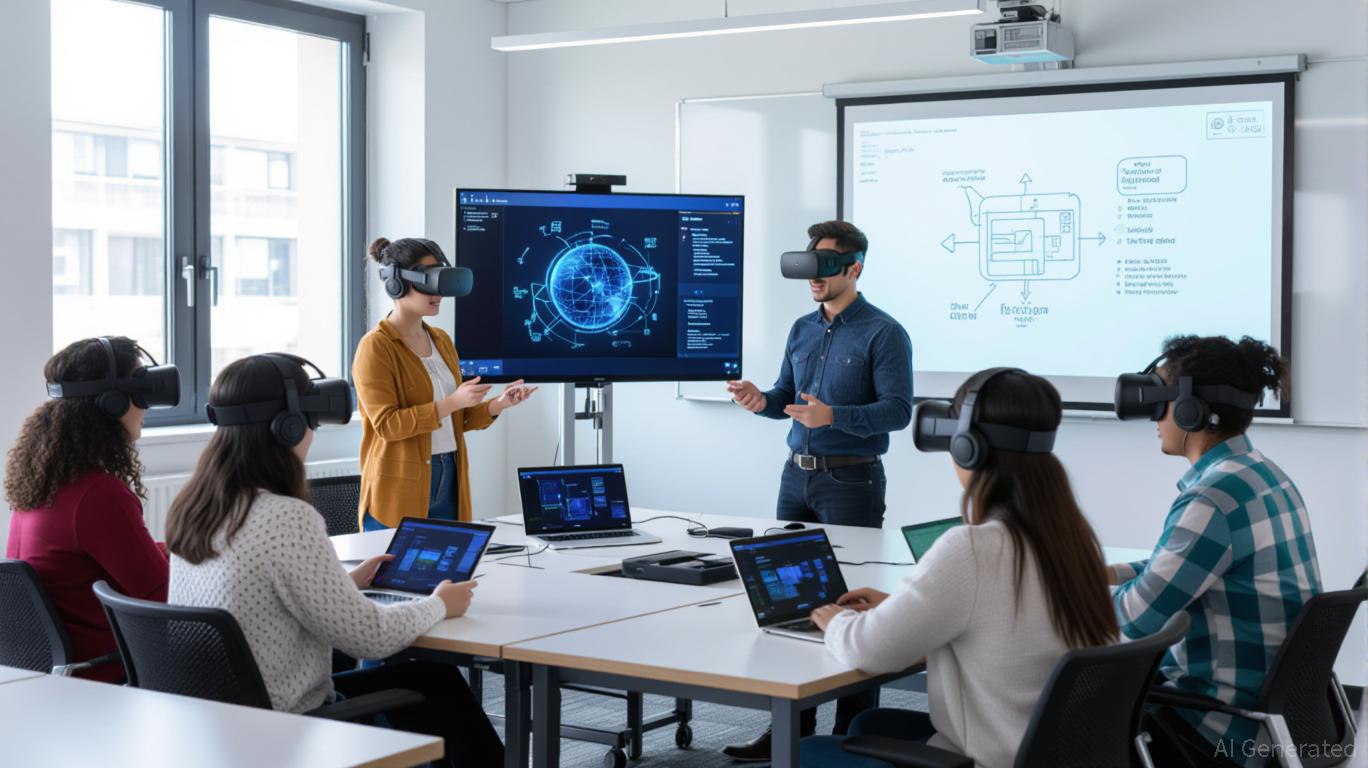
The Revival of Educational Technology in Higher Education After the Pandemic
- Global EdTech market grows to $7.3T by 2025, driven by hybrid learning and AI/AR/VR adoption in higher education. - Institutions like MIT and Harvard integrate AI across disciplines, boosting enrollment and workforce alignment through $350M-$500M investments. - EdTech platforms enabling personalized learning and immersive experiences see rising demand, with 45% annual growth in AI-related programs since 2020. - Undervalued EdTech stocks offer investment opportunities as $16B+ VC funding accelerates innov
Trending news
MoreCrypto prices
More





