
Worldcoin Meets AdTech: Human-Verified Campaigns Beat Bots, CTRs Jump 50%

Japanese ad firm Hakuhodo raised click-through rates 50% in a pilot using human verification and blockchain to eliminate bot traffic, offering new approach to digital ad fraud.
Human verification technology has proven to improve digital ad performance by increasing click-through rates by 50 percent while cutting exposure to fraudulent traffic.
Japanese advertising giant Hakuhodo partnered with Tools for Humanity and LG Electronics for the pilot. The program targeted a persistent industry problem: distinguishing real users from bots.
The Bots Problem
Digital advertisers have long struggled with fraudulent traffic that inflates impression counts while delivering no actual engagement. Industry estimates suggest a substantial portion of global ad spend—running into billions of dollars—is wasted on non-human impressions generated by increasingly sophisticated bot networks.
Traditional solutions have proved inadequate as AI-driven fraud evolves faster than detection methods. Hakuhodo’s approach took a different tack: rather than trying to identify bots, the company focused on verifying humans. The pilot used Tools for Humanity’s World ID protocol to confirm participants were real people. Each verified impression was logged to LG’s blockchain infrastructure.
The setup ensured advertisers paid only for impressions delivered to confirmed humans—a simple premise with potentially far-reaching implications for how digital ads are bought and sold.
Testing at Scale
More than 3,500 participants and over ten advertisers across electronics, travel, food, cosmetics, and education sectors joined the pilot. Hakuhodo integrated its “boba” mini-app with World ID verification and LG’s blockchain ledger, creating a closed loop where only human-verified users received ads and every impression was recorded on-chain.
The results were striking: campaigns targeting verified users showed click-through rates approximately 50 percent higher than conventional campaigns. Bounce rates—the percentage of visitors who leave immediately—dropped by around 15 percentage points, indicating deeper engagement with advertised content.
In a separate trial, Hakuhodo introduced a “Watch-to-Earn” feature that rewarded participants with points for viewing ads. This incentive mechanism drove CTR even higher, demonstrating that modest rewards can meaningfully influence user behavior when combined with verified identity infrastructure.
Broader Implications
The pilot arrives as advertisers worldwide grapple with measurement challenges posed by fraudulent traffic and AI-generated activity that increasingly mimics human behavior. Blockchain and identity verification are not new to digital advertising. However, their combination in this trial produced measurable performance improvements. The results went beyond theoretical benefits.
The approach raises questions about scalability and user adoption. Privacy-preserving verification requires users to actively participate in identity confirmation processes, which may limit reach compared to traditional ad networks. Cost considerations also remain unclear—blockchain transaction fees and verification infrastructure could offset savings from reduced fraud, depending on implementation.
Neither LG Electronics nor Tools for Humanity has published independent English-language commentary on the pilot at the time of reporting. Hakuhodo conducted the trial primarily in Japan, though its methodology may inform similar initiatives in markets where advertisers are seeking more verifiable metrics.
Market Context
The pilot unfolded against a backdrop of volatility in the Web3 ecosystem. Worldcoin (WLD), the token associated with Tools for Humanity, traded at $0.96 as of publishing, down from $1.35 earlier in the week after touching a low of $0.89 on October 11. The price movements reflected broader market trends and investor sentiment rather than any direct connection to the advertising trial.
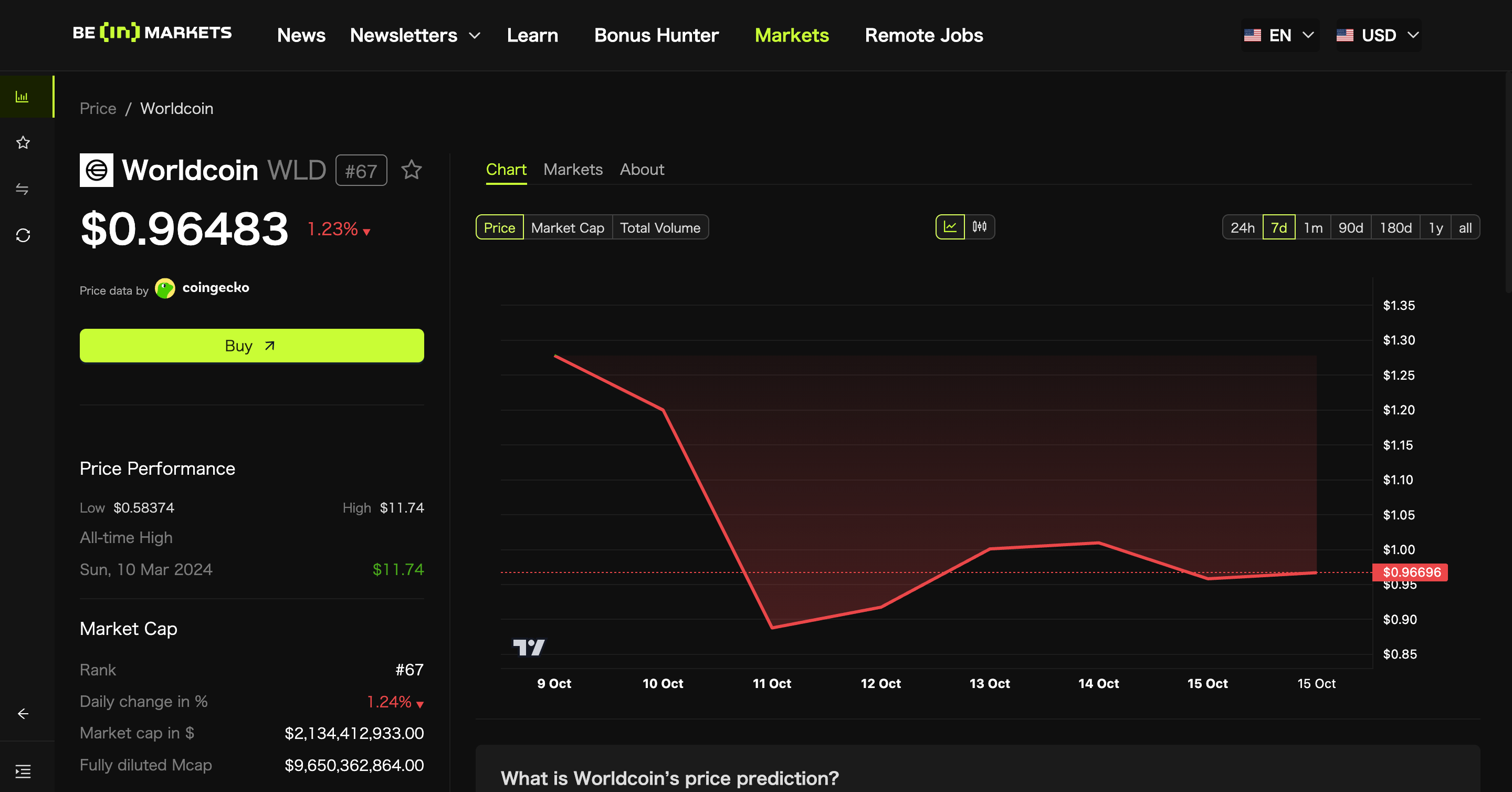 Worldcoin price chart:
Disclaimer: The content of this article solely reflects the author's opinion and does not represent the platform in any capacity. This article is not intended to serve as a reference for making investment decisions.
You may also like
Ethereum Staking Weekly Report December 1, 2025
🌟🌟Core Data on ETH Staking🌟🌟 1️⃣ Ebunker ETH staking yield: 3.27% 2️⃣ stETH...

The Blood and Tears Files of Crypto Veterans: Collapses, Hacks, and Insider Schemes—No One Can Escape
The article describes the loss experiences of several cryptocurrency investors, including exchange exits, failed insider information, hacker attacks, contract liquidations, and scams by acquaintances. It shares their lessons learned and investment strategies. Summary generated by Mars AI This summary was produced by the Mars AI model, and the accuracy and completeness of its generated content are still in the process of iterative improvement.

Mars Morning News | Federal Reserve officials to advance stablecoin regulatory framework; US SEC Chairman to deliver a speech at the New York Stock Exchange tonight
Federal Reserve officials plan to advance the formulation of stablecoin regulatory rules. The SEC Chair will deliver a speech on the future vision of capital markets. Grayscale will launch the first Chainlink spot ETF. A Coinbase executive has been sued by shareholders for alleged insider trading. The cryptocurrency market fear index has dropped to 23. Summary generated by Mars AI This summary was generated by the Mars AI model, and the accuracy and completeness of its content are still in the process of iterative updates.

OECD's latest forecast: The global interest rate cut cycle will end in 2026!
According to the latest forecast from the OECD, major central banks such as the Federal Reserve and the European Central Bank may have few "bullets" left under the dual pressures of high debt and inflation.
Trending news
MoreCrypto prices
More






