
How to Understand Hyperliquid's Latest HIP-3 Upgrade in Layman's Terms?

Allow anyone to deploy a perpetual contract market.
Original Author: nairolf
Original Translation: Deep Tide TechFlow
What is HIP-3?
Here is @HyperliquidX's simple explanation of HIP-3.
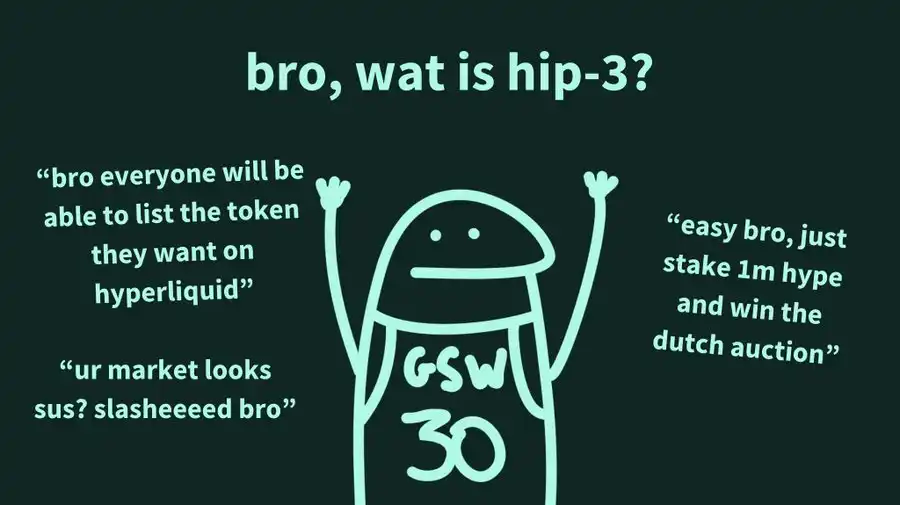
HIP-3 allows developers to deploy a perpetual contract market on HyperCore.
To ensure market quality and protect users, deployers must stake 500,000 HYPE. In case of malicious market behavior, validators have the authority to slash the deployer's stake.
You should already be familiar with HyperCore, right? It includes the state of the order book and the matching engine.
In simple terms, it is the backend of Hyperliquid's exchange.
HIP stands for Hyper Improvement Proposal. Essentially, it outlines how changes are proposed for the protocol.
The primary goal of HIP-3 is to allow anyone to deploy a perpetual contract market.

Currently, the process of adding new tokens to a perpetual contract exchange is permissioned.
This means the core team decides which tokens to add based on demand, trading volume, and other criteria.
HIP-3 enables anyone to list their chosen tokens. Yes, quite literally any token.
However, there are some restrictions. Only one token can be listed every 31 hours. Additionally, you need to win the deployment rights through a Dutch Auction (using HYPE).

You must stake 500,000 HYPE and be responsible for setting up the market.
This involves selecting an oracle, defining leverage limits, handling settlement logic, and ensuring everything operates securely.
The 500,000 HYPE serves as a security guarantee and a way for the protocol to protect itself.
If your token market experiences strange manipulation, validators can vote to slash your HYPE.
In simple terms, this HYPE is to ensure that your token listed is legitimate.
As the deployer of the token, you can claim 50% of the total market fees. You can even set an additional custom fee.
In other words, you can earn a portion of the fees from users trading the token you listed.

HIP-3 allows anyone to list a token on the Hyperliquid perpetual contract exchange.
To ensure market security, a 500,000 HYPE stake is required, and in case of suspicious activity, this stake may be slashed.

Disclaimer: The content of this article solely reflects the author's opinion and does not represent the platform in any capacity. This article is not intended to serve as a reference for making investment decisions.
You may also like
The Increasing Economic Strain of Alzheimer’s Disease and Its Effects on Healthcare Systems and Long-Term Care Industries
- Alzheimer's disease's global economic burden is projected to surge from $1.6 trillion in 2023 to $14.5 trillion by 2050, straining healthcare systems and public infrastructure. - The Alzheimer's therapeutics market is growing at 23.4% CAGR, driven by disease-modifying therapies and tech innovations like AI-driven care platforms. - Strategic investments in dementia infrastructure include $3.9B U.S. NIH funding and startups like Isaac Health securing $10.5M for in-home memory clinics. - Public-private part

Building Robust Investment Portfolios: Insights Gained from Economic Crises and Policy Actions

Hyperliquid (HYPE) Price Rally: The Role of DeFi Advancements and Investor Sentiment in Driving Recent Market Fluctuations
- Hyperliquid (HYPE) surged to $59.39 in 2025 before retreating, driven by DeFi innovations and volatile market sentiment. - Technical advancements like HyperBFT consensus and USDH stablecoin attracted 73% of decentralized trading volume, while institutional partnerships stabilized the ecosystem. - Despite short-term volatility near $36, bullish RSI patterns and $3 trillion trading volume suggest potential for a $59 rebound, though sustained momentum above $43 is critical. - Analysts project HYPE could rea
The Driving Forces Behind Economic Growth in Webster, NY
- Webster , NY, transformed a 300-acre Xerox brownfield into a high-tech industrial hub via a $9.8M FAST NY grant, boosting industrial and real estate growth. - Public-private partnerships enabled infrastructure upgrades, attracting $650M fairlife® dairy projects and 250 high-paying jobs by 2025. - Industrial vacancy rates dropped to 2%, while residential values rose 10.1% annually, highlighting synergies between infrastructure and economic development. - The model underscores secondary markets' potential
Trending news
MoreCrypto prices
More






