
Bitcoin Faces Pressure as Trade Tensions and Safe-Haven Flows Challenge Bullish Momentum

Bitcoin ended the week under pressure as investors rotated toward safer assets amid renewed US-China trade tensions and broader market weakness. Despite robust inflows into Bitcoin exchange-traded funds (ETFs), derivatives data suggest traders remain cautious about the sustainability of current price levels.

In brief
- Bitcoin retreats from a $126K record as investors pivot toward gold and bonds amid renewed US-China trade tensions.
- ETF inflows exceed $5B in October, yet derivatives show traders doubt Bitcoin’s ability to hold above key support.
- Gold reaches a record high of $4,050, reflecting heightened demand for safe-haven assets.
- Despite record ETF inflows, Bitcoin remains volatile, with macro headwinds and inflation fears weighing on sentiment.
Bitcoin Loses Momentum After New Peak
After reaching a new all-time high on Monday, Bitcoin has struggled to maintain its upward momentum. Even at that, institutional demand appears solid, with over $5 billion in net spot ETF inflows so far in October, highlighting continued interest from large investors.
However, derivatives indicators such as options skew and funding rates suggest uncertainty over Bitcoin’s ability to hold above support levels. At the time of writing, the OG coin has dropped by over 8% in the past day to $110,982, as market sentiment shifts bearish.
Meanwhile, gold surged to a record high near $4,050 on Wednesday, reflecting growing investor demand for safe-haven assets. The rally came as concerns over US fiscal stability deepened and economic growth slowed. Billionaire investor Ray Dalio warned that rising US debt levels pose a “threat to the monetary order.”
Markets turned volatile after US President Donald Trump accused China of imposing new port fees on rare-earth exports and threatened higher tariffs in response . The S&P 500 fell 1.9% as fears of an escalating trade war pressured global equities and technology shares.
Although Bitcoin is often viewed as “digital gold,” its performance remains closely tied to risk sentiment in traditional markets. The 40-day rolling correlation between Bitcoin and the S&P 500 stands at 73%. Importantly, this highlights how macroeconomic factors continue to influence the behavior of the crypto market.
Traders Turn Defensive as Derivatives and Bond Markets Flash Warning Signs
Investor caution is equally visible in the bond market. Yields on one-year US Treasuries fell to 3.61%, their lowest level in more than three years, as investors sought safety even amid persistent inflation.
The US Personal Consumption Expenditures (PCE) index rose 2.7% year over year in August, the highest in six months. As expected, this has raised concerns that inflation may pick up further in 2026 as new import duties take effect.
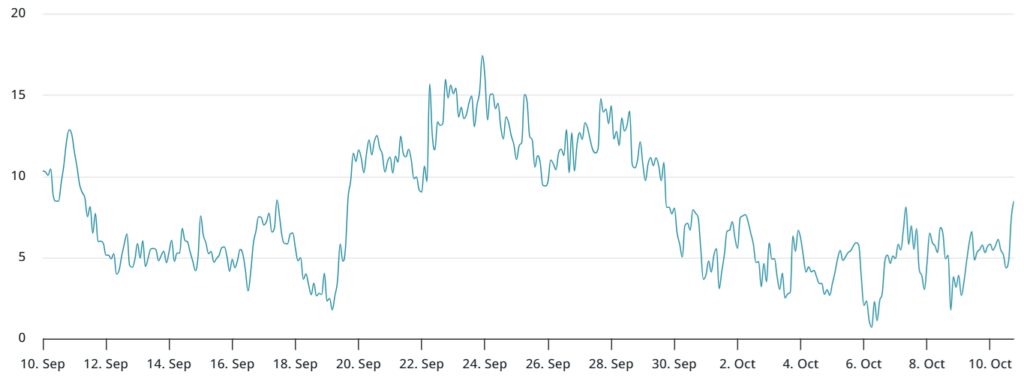
Bitcoin’s options market reflects a similar level of caution among market participants. The 30-day delta skew climbed to 8% on Friday , signaling that traders are paying a premium for downside protection. Recall that the last time this metric showed optimism was in mid-July, following a 13% two-week rally.
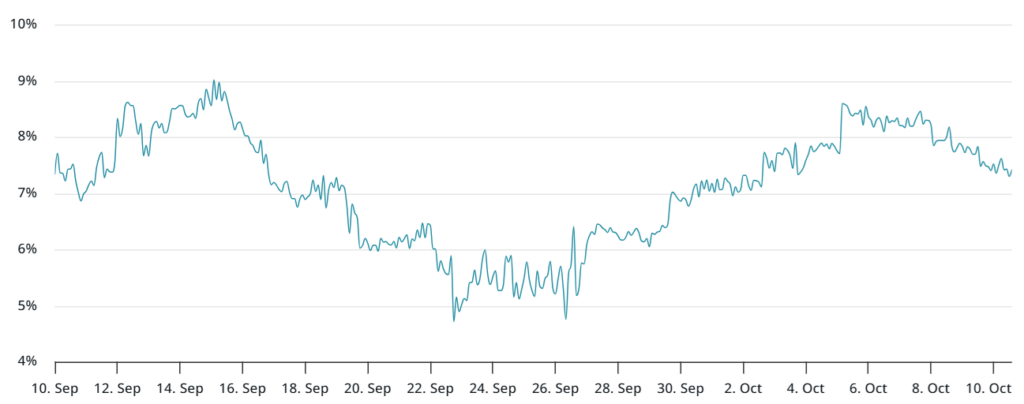
Meanwhile, monthly Bitcoin futures are trading at a 7% premium to spot prices, showing little change over the week. In bullish markets, this premium often exceeds 10% as demand for leveraged long positions increases. The steady level suggests trader confidence has yet to recover, even after Bitcoin’s 14% rally between Sept. 28 and Tuesday.
Stablecoin flows in China offer additional insight into trader sentiment. Tether (USDT), which often trades at a premium or discount—an indicator of market stress—had been slightly below parity earlier in the week, indicating outflows from crypto markets. However, after Bitcoin dipped below $120,000, the discount closed, suggesting that selling pressure has eased for now.
Bitcoin ETF Inflows Surge, Yet Traders Stay Wary Amid Macro Headwinds
Momentum behind Bitcoin ETFs is accelerating, with capital flowing into spot products at a record pace.
Here are some notable developments in the Bitcoin ETF sector:
- BlackRock’s iShares Bitcoin Trust (IBIT) now holds over 800,000 BTC , representing nearly 4% of Bitcoin’s circulating supply
- Plus, it has now surpassed $100 billion in assets under management for the first time since its launch.
- Bitcoin spot ETFs recorded $4 billion in new inflows over the past week, marking nine consecutive days of inflows and signaling strong institutional demand.
- Despite IBIT’s strong performance, the funds collectively saw a net outflow of $4.5 million on Friday.
- Bitcoin’s spot price remains under pressure, trading around $117,600, down 2.56% on the day and nearly 4% for the week, despite the continued ETF inflows.
Even though these investment vehicles have performed strongly in recent weeks , market confidence remains muted. Persistent macroeconomic risks—including trade tensions, inflation concerns, and slowing growth—continue to weigh on sentiment. Derivatives data indicate ongoing hesitation among traders, suggesting that Bitcoin may face further volatility before regaining clear upward momentum.
Disclaimer: The content of this article solely reflects the author's opinion and does not represent the platform in any capacity. This article is not intended to serve as a reference for making investment decisions.
You may also like
Evaluating the Increasing Need for Expertise in AI and Computational Fields: Discovering Investment Prospects in Educational and Training Platforms
- Farmingdale State College (FSC) expands computing programs and partners with Tesla/Amazon to address AI/data science demand. - Edtech firms like Century Tech use AI for personalized STEM learning, aligning with FSC’s need to scale enrollment while maintaining rigor. - Global AI education market projected to reach $12.8B by 2028 (33.5% CAGR), driven by corporate/university collaborations like SUNY-NY Creates TII. - Investors face risks in regulatory scrutiny and curriculum obsolescence but gain opportunit

Magic Eden to expand $ME buybacks in 2026 using revenue from Swaps, Lucky Buy, and Packs

The Emergence of Hyperliquid (HYPE): Analyzing the Latest Market Rally
- Hyperliquid (HYPE) dominates 73% of decentralized derivatives market in 2025 via liquidity innovations and hybrid trading structures. - HIP-3 protocol and two-tier architecture drive $3.5B TVL, enabling EVM compatibility and 90% fee cuts to attract DeFi projects. - Platform's 71% perpetual trading share reflects strategic buybacks ($645M in 2025) and 78% user growth amid shifting capital toward on-chain infrastructure. - Hybrid model challenges CEX dominance while facing aggregator risks, but institution

The Emergence of Tokens Supported by MMT and Their Influence on Financial Systems in Developing Markets
- MMT-backed tokens leverage blockchain to tokenize sovereign debt, real estate , and carbon credits, reshaping emerging market fiscal strategies. - Tokenized bonds enable local-currency issuance with smaller denominations, as demonstrated by Hong Kong's 2025 digital green bonds and OCBC's commercial paper program. - Central banks integrate blockchain tools for real-time liquidity adjustments, while programmable features like inflation-linked coupons enhance fiscal flexibility in volatile economies. - Chal

Trending news
MoreCrypto prices
More





