
Hong Kong Sandbox plans to focus on the Bund conference, and RWA becomes a new theme for China's Web3?
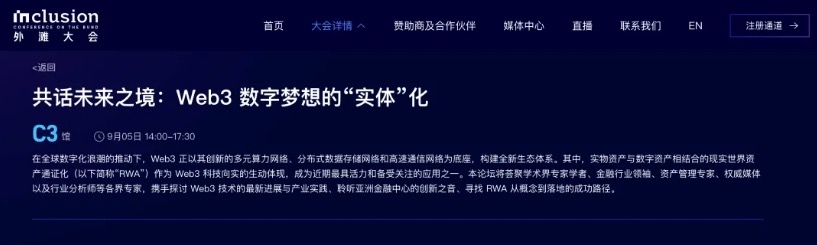
- Longxin Group Chairperson Xu Changjun delivered a keynote speech titled "Exploring the'New 'Trajectory of Investment and Unleashing the'Energy' of New Energy".
- ZAN CEO Zhang Chenguang delivered a keynote speech on "Exploration and Practice of DT RWA Empowering New Energy Industry in the VUCA Era".
- Xiao Gang, a member of the 13th National Committee of the Chinese People's Political Consultative Conference and former chairperson of the China Securities Regulatory Commission, delivered a speech titled "New Power of Financial Technology, New Engine of Digital Economy".
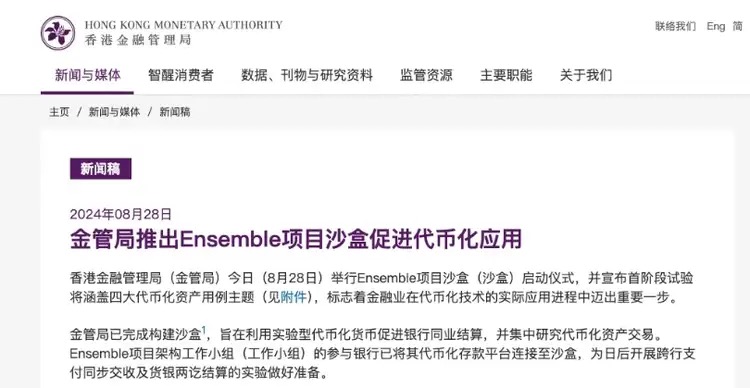
- Explore application scenarios: Allow participants to experiment with tokenized assets in a secure environment and explore various applications without immediately facing the pressure of full implementation.
- Technical Testing: Testing the compatibility between different digital assets, tokenized deposits, and CBDC. This stage is crucial to ensure the robustness of the technology and prepare for wider adoption.
- Establish industry standards: Establish common industry benchmarks for tokenization, which is crucial for the development of technology. By facilitating the entire lifecycle of tokenized asset transactions from creation to transaction to payment and settlement, Sandbox helps participants understand the actual impact of tokenization and its potential to solve real-world challenges, such as its application in supply chain financing.
- Solving real-world challenges: Sandbox promotes innovative applications aimed at solving practical problems in the financing field, especially in areas such as trade and supply chain finance. By addressing these pain points, Ensemble is helping to make tokenization a viable option for enterprises.
- Fixed Income and Mutual Funds: This topic explores how tokenization is changing traditional investment tools, making them more accessible and efficient. By creating digital representations of bonds or Mutual Funds, the financial industry can reduce settlement time, lower costs, and enhance liquidity, providing new opportunities for investors.
- Liquidity Management: Tokenization has the potential to revolutionize liquidity management by allowing assets to be split and traded on digital platforms. This could lead to more dynamic and efficient liquidity management, especially where quick access to funds is critical.
- Green and Sustainable Finance: The MAS also focuses on how tokenization can support green and sustainable finance initiatives. By tokenizing assets such as green bonds or carbon credits, the financial sector can enhance transparency and traceability, ensuring that funds are effectively allocated to environmental projects.
- Trade and Supply Chain Finance: Tokenization can solve major pain points in trade and supply chain finance by simplifying the process of tracking and transferring ownership of goods and financial assets. This can improve the efficiency and transparency of the supply chain, reduce fraud risks, and enhance overall market confidence.
- Enhance liquidity. Traditional real-world assets like real estate tend to be illiquid, meaning they can be difficult to sell quickly. Tokenization allows these assets to be split into smaller tokens that are easier to trade, improving liquidity.
- Increase accessibility. Tokenization makes asset classes that were previously inaccessible to many investors more widely accessible. For example, people with limited capital can purchase a small portion of high-value assets (such as real estate) through tokens.
- Reduce transaction costs. Blockchain technology can reduce the cost of trading and transferring assets as it eliminates the need for intermediaries such as brokers or custodial agents.
Disclaimer: The content of this article solely reflects the author's opinion and does not represent the platform in any capacity. This article is not intended to serve as a reference for making investment decisions.
You may also like
The Increasing Economic Strain of Alzheimer’s Disease and Its Effects on Healthcare Systems and Long-Term Care Industries
- Alzheimer's disease's global economic burden is projected to surge from $1.6 trillion in 2023 to $14.5 trillion by 2050, straining healthcare systems and public infrastructure. - The Alzheimer's therapeutics market is growing at 23.4% CAGR, driven by disease-modifying therapies and tech innovations like AI-driven care platforms. - Strategic investments in dementia infrastructure include $3.9B U.S. NIH funding and startups like Isaac Health securing $10.5M for in-home memory clinics. - Public-private part

Building Robust Investment Portfolios: Insights Gained from Economic Crises and Policy Actions

Hyperliquid (HYPE) Price Rally: The Role of DeFi Advancements and Investor Sentiment in Driving Recent Market Fluctuations
- Hyperliquid (HYPE) surged to $59.39 in 2025 before retreating, driven by DeFi innovations and volatile market sentiment. - Technical advancements like HyperBFT consensus and USDH stablecoin attracted 73% of decentralized trading volume, while institutional partnerships stabilized the ecosystem. - Despite short-term volatility near $36, bullish RSI patterns and $3 trillion trading volume suggest potential for a $59 rebound, though sustained momentum above $43 is critical. - Analysts project HYPE could rea
The Driving Forces Behind Economic Growth in Webster, NY
- Webster , NY, transformed a 300-acre Xerox brownfield into a high-tech industrial hub via a $9.8M FAST NY grant, boosting industrial and real estate growth. - Public-private partnerships enabled infrastructure upgrades, attracting $650M fairlife® dairy projects and 250 high-paying jobs by 2025. - Industrial vacancy rates dropped to 2%, while residential values rose 10.1% annually, highlighting synergies between infrastructure and economic development. - The model underscores secondary markets' potential
Trending news
MoreCrypto prices
More






